Customer Retention Risk During M&A Narrative Transitions
Executives underestimate how silence between announcement and close drives customer defection.
Customer attrition during a merger is a story problem, and the numbers back that up harder than most executives want to admit.
Post-merger attrition rates run as high as 20 to 30 percent. That's a fifth to a third of a customer base deciding, somewhere in the chaos, that leaving is easier than waiting to find out what happens next. And the customers who leave first tend to be the ones a company can least afford to lose. The old 80-20 rule applies here with a vengeance: 80 percent of bank revenue and profit comes from just 20 percent of customers, and those high-value accounts are usually the ones with the most options. They don't wait around to see how the story ends.
Take Independent Bank Corp. and Enterprise Bancorp. Across the ten biggest bank mergers of 2025, average deposit loss came in around 3 percent. Sounds almost survivable, until you look at the outliers. First Union's merger with CoreStates lost 20 percent of inherited customers when integration fell apart. Averages are comforting. Outliers are where the actual damage lives.
Customers are three times more likely to switch providers after a merger, and the event itself triggers the consideration, regardless of how good the underlying product or service actually is. Not a rate hike, not a bad customer service call, just the announcement.
Most companies blame this on operational friction: new systems, closed branches, shifting fees. That explanation skips what actually matters. By the time a customer experiences friction, they've usually already decided to leave. The decision forms earlier, in the gap between announcement and integration, when nobody's told them anything and their imagination fills in the blanks. Attrition is the outcome. The real event happens weeks or months before, in total silence.
What fills the silence between announcement and closing
Silence is never actually silent. The second a deal gets announced, every stakeholder starts building their own theory of what it means, and most of those theories assume the worst.
Three things move into that vacuum, and none of them are things the acquiring company controls. Customers start speculating, filling gaps with assumptions that skew pessimistic because that's just how uncertainty works. Competitors don't wait for anyone's press release. They move with a story while the acquirer is still drafting talking points internally, and whoever gets there first with a coherent narrative effectively defines the transition for everyone watching. And employees, the people who actually deliver the customer experience, sit in their own limbo. Key talent walks during the gap between signing and closing, often because nobody bothered telling them they mattered to the combined company. Once they're gone, customers notice, and that departure becomes its own signal that something's wrong.
Delayed brand decisions don't stay internal, either. When employees don't know how to describe the combined company to a customer, they default to two options: silence or contradiction. Both get read by the customer as a sign that something's off, even when nothing operationally has actually changed yet.
The instinct to stay quiet, to protect against legal exposure or premature disclosure, feels responsible in the moment. It backfires almost every time. The silence a company thinks is protecting it ends up manufacturing the exact narrative that has to get unwound, expensively, after close. It's an infrastructure gap. Companies without a story built in advance simply have nothing to deploy the moment the clock starts running, and by the time they scramble to write one, the vacuum's already been filled by somebody else.
The strongest serial acquirers treat communications as deal infrastructure, on par with legal or financial due diligence, because it protects the value they just paid for. The vacuum isn't a communications inconvenience. It's a financial risk with a dollar figure attached, same as any other line item on the deal.
The four stakeholder clocks that are already running before the ink dries
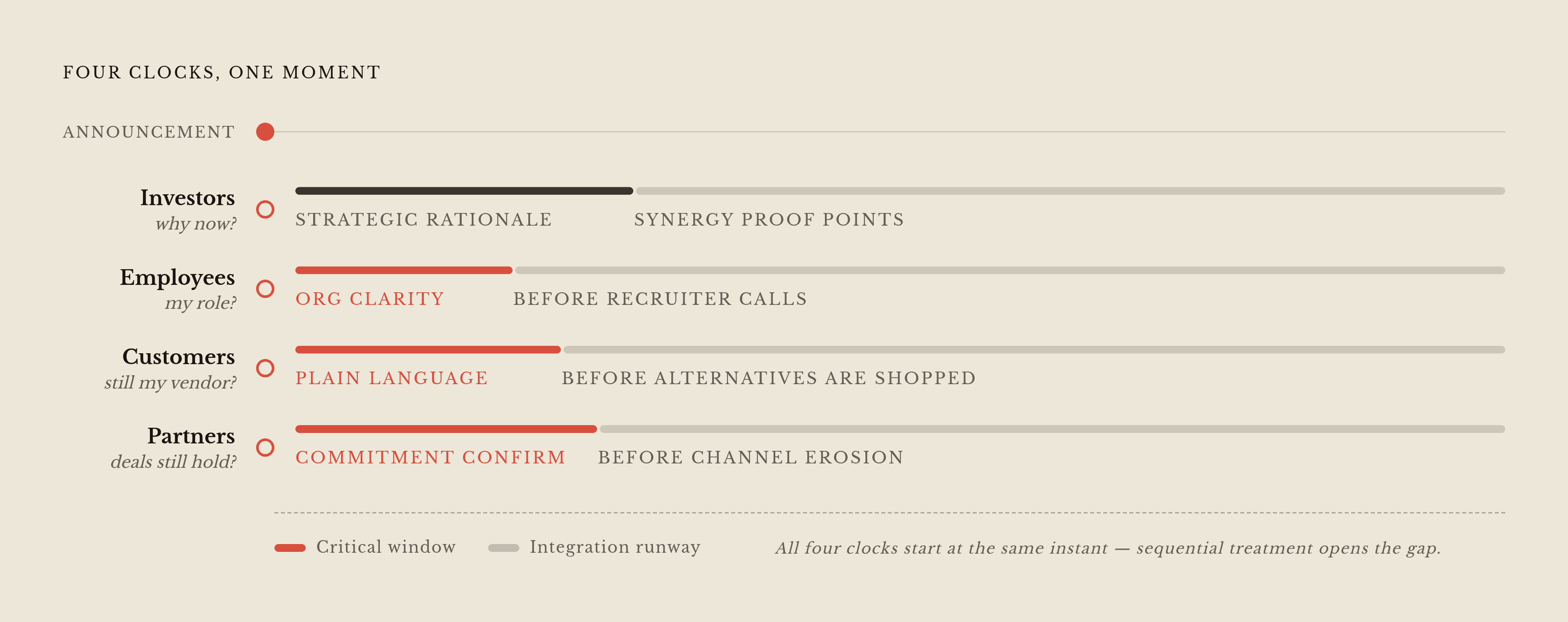
Every M&A deal runs four separate clocks at once, and every one of them starts ticking the moment the announcement goes out, not a day later.
Customers are running one clock. They need plain language, fast, about what's changing and what isn't, before they start shopping around for alternatives. Employees are running a second. They need to know where they land in the new org chart before a recruiter's LinkedIn message starts looking appealing https://reedmackay.com/corporate-travel-management. Partners and channel are running a third, and what they need most is confidence that the commitments made before the deal still hold after it. Investors and the broader market run the fourth clock, and they're not looking for deal mechanics, they want the strategic logic, the "why this, why now" of the whole thing.
Most companies get the sequencing wrong in a completely predictable way. They tell investors first, then employees, then customers, treating the four audiences like a waterfall instead of four rivers hitting the same delta at once. That sequencing is exactly the gap competitors exploit. While the acquirer is still working through its internal announcement order, a competitor's sales rep is already on the phone telling the acquirer's own customers a different story.
The fix isn't speed for its own sake, it's preparation done long before signing. That means stakeholder maps built ahead of time, spelling out who needs to know what and when. It means scenario-ready talking points instead of a scramble. It means pre-written statements in case of a leak, and FAQ documents ready for managers who'll otherwise improvise answers on the spot. None of this gets written well under pressure. It has to exist before the pressure starts.
There's a test almost nobody runs before signing: can the existing brand story actually stretch to cover this acquisition? If the answer is no, the company doesn't have the language to absorb the deal narratively, no matter how cleanly the deal closes on paper. A clean legal close and a coherent story are two completely different finish lines, and only one of them appears in the press release.
What narrative infrastructure looks like in practice
Some real examples make this concrete, and one in particular comes with an actual dollar figure attached to the moment a story ended.
Navan acquired Reed & Mackay, a UK-based travel management company, in 2021. Fast forward to January 2026, and Navan announced it would unify everything under the Navan brand, moving R&M's existing customers onto the Navan platform and retiring the R&M name for new sales immediately. Navan's own Form 10-K (FY2026) noted that while overall customer retention remained strong, there was uncertainty about the degree to which the transition to the Navan technology platform would impact relationships with existing R&M customers. Navan recognized the remaining $36.2 million of amortization tied to the R&M trade name intangible asset, all at once, in January 2026 Navan, Inc. - Form 10-K - FY2026. That $36.2 million sat on the balance sheet as long as the R&M story still meant something to somebody Navan, Inc. - Form 10-K - FY2026. The day the company decided the old story was over, the asset went to zero Navan, Inc. - Form 10-K - FY2026. A brand name is worth real money right up until the day a company decides it isn't.
Compare that to Salesforce and Slack. Salesforce kept Slack operating under its own distinct brand identity after the acquisition, preserving the equity Slack had built while still signaling the strategic tie to Salesforce. That wasn't an accident, it was a deliberate call about which story to keep alive and which to fold in.
Or look at Westpac's acquisition of St. George Bank, which set an explicit target from day one: zero customer loss. Relationship managers personally visited wealth management clients instead of sending a form letter. Marketing campaigns told retail customers, directly, that they'd gain access to a bigger ATM network. The result held, because the narrative decision came before the integration decision, not as an afterthought bolted onto it after the systems were already merged.
Changing how a company talks about itself is never a light lift for customers. People are creatures of habit, and a company's name and communication style are woven into the relationship, not separate from it. The companies that handle this well don't try to manage that discomfort away quietly. They architect around it, on purpose, ahead of time. Navan and Reed & Mackay together illustrate a clear example of narrative transition risk with a measurable financial consequence.
Language debt accumulated before the deal closes as a multiplier of post-close churn
Ward Cunningham coined the term "technical debt" back in 1992, describing how shortcuts in code quality make every future change harder and slower. The same logic applies almost exactly to how a company talks about itself. Call it language debt: fragmented terminology, inconsistent messaging, undefined narratives, all quietly degrading performance until a merger comes along and makes the bill due all at once.
This debt appears in three specific places before a deal even closes. First, sales and marketing misalignment. Only 30 percent of sales professionals report strong alignment with marketing, even though aligned companies show a 103 percent higher likelihood of hitting their goals. Merge two companies, and you're not averaging two debts, you're stacking them. Second, undefined customer language: when Sales and Marketing operate from different mental models of who the customer even is, the merger exposes that gap immediately, in front of the customer, in the form of contradictory messaging. One practitioner put it bluntly: most organizations don't really have clarity on their ideal customer profile, they pay it lip service without ever executing against it. Third, inconsistent external positioning, where the acquired company's customers heard one story and the acquirer's customers heard another, and post-close both groups get handed some blended version that satisfies neither.
Whether to preserve two separate brands or unify under one depends entirely on how distinct the customer bases are, and that decision requires a clear read on what each brand's language actually promises, and to whom. Companies carrying unresolved language debt can't make that call cleanly. They inherit a compounding cost that appears in every customer communication that goes out after close.
This isn't just a perception problem, either. Inconsistent customer language appears disproportionately in early churn cohorts, and while CRM and analytics tools can flag high-risk segments, they only work if the company has a coherent enough model of its customers to segment against in the first place. Garbage language in, garbage segmentation out.
How AI deployed on fragmented narrative scales the problem instead of solving it
AI doesn't fix a fragmented narrative. It photocopies it, at scale, to every customer touchpoint simultaneously.
An AI system trained on pre-merger content will keep pushing the old story out into the world, right at the exact moment the combined company most needs consistency. InformationWeek's enterprise AI predictions flag exactly this failure mode: most unstructured data gets collected across dozens of tools without any real quality control, producing what gets called "data noise", too many copies, outdated versions, conflicting versions, all tangled together. In an M&A context, that noise has a name and a face. It's the chatbot still mentioning the discontinued brand. It's the sales enablement tool still pitching the old product name. It's the customer-facing AI agent repeating the original value proposition months after the company announced a new one.
This has gotten serious enough that "Enterprise Prompt Debt" now gets classified as an actual financial liability, ranked right alongside retrieval debt and evaluation debt. Gartner projects $644 billion flowing into GenAI tooling by 2025, and yet MIT NANDA research found 95 percent of pilots delivered zero impact to the P&L. That mismatch isn't a technology failure. It's a narrative governance failure wearing a technology costume.
AI has also become a participant in go-to-market motion, not just a tool sitting off to the side. ZoomInfo's 2026 predictions describe AI as exposing GTM dysfunction faster than any consultant ever could, surfacing every broken handoff and every gap in the customer journey with what they call brutal clarity. That's a double-edged sword during M&A. Deploy AI into a post-close environment before narrative infrastructure is sorted out, and integration doesn't speed up. The contradiction just gets broadcast to every customer, all at once, instantly.
Most organizations don't have basic rules for who can deploy which model under what policy, producing a governance gap that mirrors how brand language goes undocumented, with usage guidelines living as tribal knowledge instead of written policy.
Why narrative discipline is now a valuation input
Median M&A valuations fell to 9.2x EV/EBITDA in 2025, the lowest median multiple Capstone Partners has recorded in 10 years of tracking, down from a historical median of 10.5x. And yet acquirers kept paying up, specifically, for businesses that could show strong customer retention, real competitive moats, pricing power, and steady cash flow.
Retention is already priced into deals. Narrative infrastructure is the mechanism that either produces that retention or quietly destroys it during the transition. Barclays' 2026 M&A outlook frames narrative discipline and proactive shareholder engagement as central to whether a deal gets embraced or fought, and it's careful to frame that as deal execution risk, not a PR nicety.
2026 looks like a conviction cycle rather than a volume cycle. Strategic, decisive action defines the environment, and the logic behind megadeals has actually strengthened, since larger transactions tend to deliver better synergy capture and stronger valuation re-ratings. Companies without a clear category story walk into these deals exposed, unable to explain the combined entity's logic to any of the four stakeholder clocks running against them.
Consumer M&A deal volume dropped 18.9 percent year over year in 2025, with public strategic acquisitions contracting a steep 33.8 percent. But not every sector shrank. Tactical Products grew 54.3 percent year over year, Outdoor Recreation grew 47.7 percent, and both happen to be sectors where strategic identity was already sharp before any deal talk started. The sectors that held up were the ones that knew who they were.
Acquirers are doing the math on this. A target that's governed its own narrative, that can show retention stability and consistent customer language across its go-to-market, is underwriting a lower integration risk. Lower risk gets rewarded with a higher multiple, plain and simple.
Building narrative infrastructure before the deal, what governance looks like in practice
Narrative infrastructure isn't a messaging deck someone assembles once a deal is in motion. It's the language system a company already has running before any deal talk starts, which is why building it under deal pressure never works. There isn't enough runway to build it fast enough once the clock's already ticking.
Four things need to exist before the LOI is even signed. Stakeholder maps, first, spelling out who needs to know what, at which point across each of the four clocks, and at what level of detail. Scenario-tested talking points, second, written for multiple possible deal shapes and leak scenarios well ahead of time, not drafted in a panic while legal and PR are both burning the midnight oil. A brand narrative stress test, third: an honest gut-check on whether the current brand story can actually stretch to cover an acquisition, because if it can't, the company is missing the language infrastructure to absorb the deal no matter how smoothly it closes on the legal side. And canonical language documents, fourth, the single source of truth for how the combined company describes itself, its customers, its category, and what it actually offers, the kind of document that prevents the contradictions that quietly compound into churn.
The brand architecture decision, same buyers or different buyers, similar offerings or new ones, is fundamentally a language decision before it's ever a design decision. Mapping that matrix cleanly requires language that's already clean. Feeding it fragmented language makes the matrix spit out ambiguity dressed up as a strategy.
Sources
- M&A Case for a Customer-First Playbook
- Annual Consumer M&A Report | Capstone Partners
- Navan, Inc. - Form 10-K - FY2026
- M&A Communications Strategy: The 4 Clocks to Manage
- The profile of M&A in 2026 | Barclays Investment Bank
- Why Customer Churn Analysis is Important in SaaS M&A
- Transactions: 16 Trends in M&A Communications in 2025 | Poston Communications
- Communicating a Merger or Acquisition: A Strategic B2B Framework for 2026