
Quantifying Language Debt on the Balance Sheet
Measuring the hidden cost of misaligned messaging across your organization.
Language debt is what happens when a company's words stop matching its work, and nobody's tracking the gap. Every growing company has a finance team watching cash burn. Mature tech shops track technical debt down to the sprint. Almost nobody tracks the cost of a message that's drifted, split into five versions, or just plain confused the last three customers who heard it. This piece builds the accounting for that blind spot, because "our messaging feels off" is not a budget line, and it should be.
What language debt is, and how it accrues
Bad grammar isn't the problem. Neither is a clunky sentence in the onboarding deck. Language debt is the accumulated cost of a story that's fractured, one where what the company actually means and what its language actually says have quietly come apart. It builds up in three places.
Inside the walls, teams solve for their own corner of the business instead of a shared playbook. Sales calls it a "platform." Product calls the same thing a "feature." Support calls it "the thing that breaks on Tuesdays." Research on narrative infrastructure inside organizations points to this exact pattern: local optimization creates friction the moment two departments have to talk to each other about the same thing using different words.
Outside the walls, customer-facing language drifts from what the product does. A gap between customer-facing language and what the product does creates friction with customers, and that friction works against the sales process. Then there's the systemic layer, the newest and fastest-moving one: once a company hooks its workflows up to AI tools, whatever language it runs on gets copied and pasted at scale, typos and all. Feeding a language model a muddled internal vocabulary causes it to hand back muddled outputs with total confidence. That's not a bug. That's the tool doing exactly what it was asked.
The compounding works the same way financial debt does. A 2025 framing of "culture debt" makes the comparison directly: small gaps left alone don't stay small, they get more expensive and harder to fix the longer they sit. A single unclear phrase in a pitch deck costs nothing today. Multiplied across forty sales reps and eighteen months, it's costing real money nobody's assigned to a spreadsheet.
Two terms get used interchangeably and shouldn't be. Communication debt, as some researchers frame it, is about individual fluency: hiring signals, coaching gaps, whether people can write a clear email. Language debt, the way this piece uses it, sits one level up. It's about the handful of stories a company runs its whole strategy on, and whether those stories are consistent, current, and actually true. Both kinds of debt pile up. This piece stays focused on the strategic layer, because that's the layer a CEO or a CFO is actually accountable for.
Research from the Embedding Project, built on more than a hundred interviews across twenty global companies over four years, found that most companies run on roughly three to five dominant narratives. Leadership shapes them, sure, but so does the wider organization, in ways leaders don't always notice. Those three to five stories are the raw material. When they drift apart, contradict each other, or just never get checked, that's language debt accruing in real time.
The dollar cost of letting language debt compound
Grammarly's 2025 State of Business Communication report put a number on bad communication broadly: up to $1.2 trillion a year in cost to businesses in one large economy. businesses. That's bigger than the GDP of plenty of countries. That's a big number doing a lot of work, and it deserves scrutiny rather than repetition.
That $1.2 trillion covers all communication friction, not just language debt specifically. Some of it is accent bias, some of it is bandwidth and Slack overload, some of it is just people being bad at meetings. The cost that traces back to a fractured narrative, an unclear strategic story, or vocabulary that means one thing in marketing and another thing in engineering belongs to language debt.
The technical debt research gives a useful stand-in for scale. IBM research found that ignoring technical debt cuts the return on AI investment by 18 to 29 percent. That's not a small tax, and the same drag logic applies to language debt as AI tools spread through a company's workflows. Feeding inconsistent language into automated systems causes the inconsistency to spread rather than stay contained. It scales right along with everything else.
Break the cost down by department and the diffusion becomes obvious. Training teams eat longer onboarding when there's no consistent language to teach from. Sales watches deals stall out because the pitch doesn't speak the buyer's own words for their own problem. Operations managers spend their days re-explaining things that should've been clear the first time, instead of actually managing. HR performance reviews get murkier when expectations live in vague language nobody agreed on. And in Finance, narrative fragmentation produces a string of small efficiency losses spread across a dozen budget lines, none of them labeled "narrative fragmentation," so nobody connects them.
The shape of the cost is the actual problem. It's real money, spread so thin across so many line items that no single manager ever looks like the owner. Nobody gets fired for language debt because nobody's job description includes noticing it. Building a ledger for it is what finally makes someone accountable.
How technical debt got on the balance sheet, and what language debt can borrow from that history
Ward Cunningham coined "technical debt" back in 1992, and it still took decades before engineering leaders could get executives to treat it as a line item instead of a complaint. Part of the delay was a translation problem: engineers said "we have a code problem," and executives heard "engineers are grumbling again." That gap between what was said and what landed is, fittingly, its own small case of language debt.
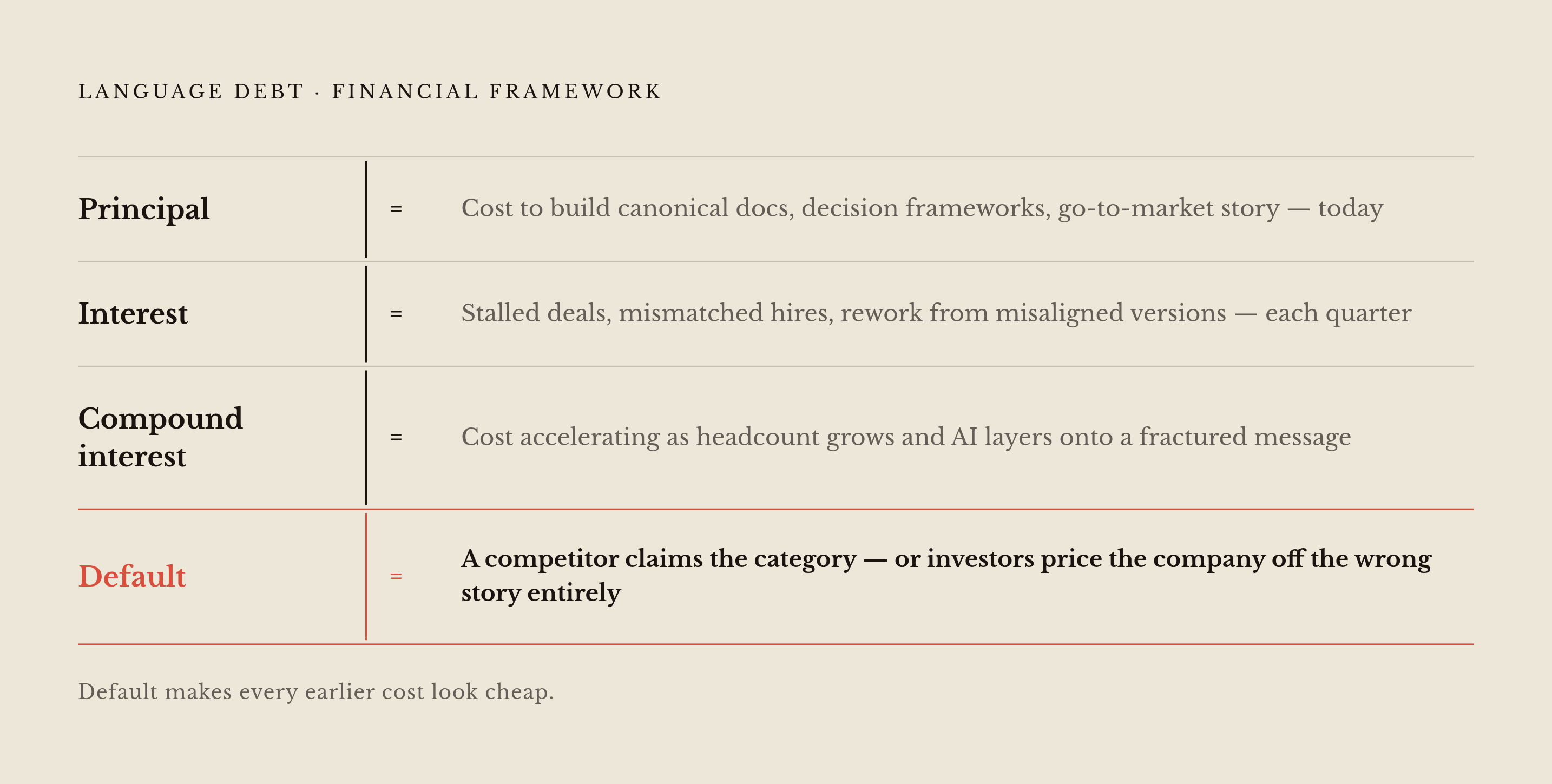
What finally got technical debt onto the balance sheet was financial framing. Principal became the cost to fix the mess today. Interest became the productivity bled out every month it stayed unfixed. Compound interest was the cost accelerating the longer it got ignored. And default was the outage, the breach, the 2 a.m. page that finally forced the conversation nobody wanted to have.
That structure maps onto language debt almost without adjustment. Principal is the cost of running a narrative audit and actually building the canonical documents, decision frameworks, and go-to-market story a company should've had from day one. Interest is what gets lost each quarter the debt sits there: stalled deals, mismatched hires, teams redoing work because they built off different versions of the same idea. Compound interest kicks in as headcount grows and AI tools get layered on top of an already-fractured message. Default is the moment a competitor claims the category first, or investors price the company off the wrong story entirely.
One example from the technical debt world shows why the translation matters so much. An engineer, instead of telling leadership "we have technical debt," reframed it as: support tickets are costing $35,000 a month because of a release that got rushed out the door. Same underlying reality. Different sentence. The budget got approved on the spot. That's the whole lesson for language debt in one anecdote: the number is what gets a meeting on the calendar.
Five categories of language debt cost that can be measured
Sales cycle drag. When a company's language doesn't match how the buyer already talks about their own problem, every single call starts with translation instead of progress. Measure it through average days-to-close on deals where the pitch aligned with the buyer's vocabulary versus deals where it didn't, and through the spread in quota attainment between reps who've internalized the real story and reps who are still riffing off an old deck. The stakes are real: vocabulary leadership in a market shapes how buyers frame their own problems, and companies that cede that ground end up competing on someone else's terms.
Onboarding and ramp-time inflation. No canonical narrative means every new hire builds their own private theory of what the company does and why it matters, usually somewhere around week three. That's measurable in time-to-productivity for new sales, marketing, and customer success hires, and in how often "what do we actually say about this" pops up in Slack. The compounding logic here is blunt: communication gaps that slow each hire individually add up to significant training cost across an organization hiring at any real volume.
Cross-functional friction and decision latency. Narrative infrastructure research finds that without a shared frame for weighing trade-offs, teams optimize locally and collide constantly. Measure it in the ratio of meetings to actual decisions made, in how many escalations exist purely because two teams meant different things by the same word, and in how much time senior leaders spend re-litigating calls they already delegated. One 2025 case study on culture debt found employees at a technology firm spending roughly 40 percent of their time in alignment meetings instead of making decisions. After a targeted reduction effort, decision cycle times dropped 62 percent, recovering almost half the company's decision-making time. That's not a soft number. That's a company getting almost half its decision-making time back.
AI amplification cost. A Datanami survey cited in recent research puts LLM adoption across business workflows at roughly 58 percent. Every one of those companies is now running its language through a machine that repeats it faster and louder. A 2026 analysis of organizational debt tied to automated language tools makes the mechanism plain: once shared language disappears, leaders stop knowing which version of a document is the actual reference copy. AI doesn't fix that confusion. It multiplies it. Measure this through how often AI-generated content needs a human to fix it for consistency, and through how many competing "versions" of one core message are floating around in AI-assisted drafts at any given time. IBM's 18-to-29-percent ROI drag from technical debt is the best available benchmark for the direction of travel here, even though language debt's exact number will differ company to company.
Category and investor mispricing. When a company's technology has outrun the market's vocabulary for describing it, that company doesn't get misunderstood, it gets mispriced. Research on category creation consistently finds that whoever defines the category early captures a disproportionate share of market value. Everyone else splits what's left, competing on the leader's terms because they never built their own vocabulary. Measure this by checking whether analyst or investor language echoes the company's own framing or defaults to a rival's definition of the market. It's the hardest of the five to pin to an exact figure, and arguably the most expensive: a fundraise priced off the wrong story, or a category window missed entirely, dwarfs anything lost to a clunky onboarding doc.
What narrative infrastructure looks like when it's working, and how its absence gets diagnosed
Working narrative infrastructure looks like muscle memory. Research on the topic finds that organizations with it can make consistent, strategically sound calls at every level without a VP sitting in every room to referee. That's the whole point: the story does the coordinating so people don't have to.
Three signs it's actually functioning. First, the guidance is precise: it tells people when a situation calls for careful process and when it calls for moving fast. Second, it flexes across contexts without snapping, bending for a new market or a new team while keeping the core intact. Third, it gets reinforced by everything around it: who gets promoted, what gets funded, what leadership actually rewards versus what leadership says it rewards.
The Embedding Project's research (that same four-year, hundred-plus-interview study across twenty companies) surfaced a hard truth. Most companies carry three to five dominant narratives, and most can't name them on request. Fewer still can say which ones are actually driving decisions versus which ones are just framed nicely on the careers page.
A short audit gets at the gap fast. Pull five senior leaders at random and ask each one, separately, what problem the company solves and for whom. Do the answers match, or do they sound like five different companies? Check whether the language in AI-generated output matches the language in the board deck, or whether it's quietly drifted. Watch how long it takes, once a competitor names the category differently, before that competitor's language appears in your own team's Slack messages. And ask, honestly, whether the gap between the internal story and the external market position is visible to anyone, and to whom.
There's a term for that exact gap. A 2022 paper in Innovation: The European Journal of Social Science Research calls it "narrative discrepancy," the divergence between a company's internal story and how it reads from the outside. It's a useful label, mostly because it finally gives the gap a name leaders can put in a memo instead of gesturing at vaguely in a meeting.
AI's role in making language debt urgent, not just important
AI doesn't create language debt. It just steps on the gas pedal for whatever debt already exists. Feeding it a fractured narrative causes the fracture to spread faster and further than it ever could by hand. Feeding it a precise narrative causes the precision to compound instead. Same tool, opposite outcome, entirely dependent on what went in.
A 2026 analysis of organizational debt tied to automated language tools lays out the mechanism: once usage spreads across a company without a shared vocabulary underneath it, errors travel faster and wider, and leadership loses track of which version of a message is even the correct one. Nobody planned for that. It's just what happens when you scale a mess.
Research published in the California Management Review out of UC Berkeley Haas in June 2025 frames the dominant story a company tells itself about AI as a kind of mental shortcut, a way of making sense of something complicated enough to otherwise cause paralysis. Which story a company adopts about AI shapes its entire governance posture around the technology. That means narrative strategy and AI strategy are the same conversation now, whether leadership has noticed or not.
The research names four archetypes companies tend to fall into. Treating AI as an augmenter leads the company to run small pilots, adapt step by step, and learn as it goes. Treating AI as an ally produces a culture that gets experimental, flexible, and built around fast feedback loops. Treating AI as a weapon locks the company down into compliance mode, heavy on protocol, slow to change anything. Treating AI as a monster causes the company to either freeze entirely or overcorrect wildly based on a worst-case scenario that may never happen. Four different stories, four completely different companies, same underlying technology.
A sharper risk causes all of this, shown by research on large language models and disinformation, published through a federal health research agency, which found that text generated by one model can be more persuasive than human-written text. Research on large language models and disinformation, published through a federal health research agency, found that text generated by one model can be more persuasive than human-written text. Pointing that inward, at a company already running on ambiguous internal language, causes the tools built to communicate faster to spread confusion faster instead, dressed up as confidence. With roughly 58 percent of businesses already adopting these tools across workflows, the ones that haven't fixed their language debt first aren't dodging the cost. They're compounding it, one AI-generated Slack message at a time.
Building the language debt ledger: a working framework for leaders
Three columns, same structure that got technical debt taken seriously in the first place.
Principal outstanding: what it actually costs to build a working narrative infrastructure from where the company sits today. That means the canonical documents, the decision frameworks, the language systems built for automated tools, and the go-to-market story, all built once and built to actually last instead of getting rewritten every time someone new joins the leadership team.
Monthly interest: what the debt costs, quarter over quarter, while it sits unaddressed. Pull it straight from data that's probably already sitting in a dashboard somewhere. CRM data shows the sales cycle drag. HR data shows the onboarding inflation. Meeting logs and escalation counts show the decision latency. AI correction frequency shows how much cleanup the fragmentation is costing on the content side.
Compounding risk: the category and investor mispricing exposure. Harder to nail to an exact number, sure, but not impossible to estimate. Frame it as a range, built off comparable fundraise outcomes or how competitors have fared after losing (or winning) the fight to define their own category.
None of this needs new software or a consulting engagement that eats a whole fiscal quarter. It needs someone in the room willing to ask what the fractured story is actually costing in dollars per quarter, then write the answer down somewhere a CFO will actually read it. Technical debt earned its line item because someone finally did the math out loud. Language debt is waiting on the same someone.