
Revenue Leakage From Inconsistent Sales Messaging
Inconsistent messaging between teams costs companies millions in lost deals and enterprise value.
A prospect opens the proposal four times. Nobody follows up. Two weeks later, the deal closes with a competitor who told a clearer story. That's revenue leakage in its purest form: SpurIQ's 2026 research defines it as the gap between the revenue a business should collect and what it actually collects, because the buyer signaled interest and nobody acted on it in time. It's an execution problem, and the piece of it that gets the least attention is language. It's an execution problem, and the piece of it that gets the least attention is language.
How much the leakage costs, across billing and narrative both
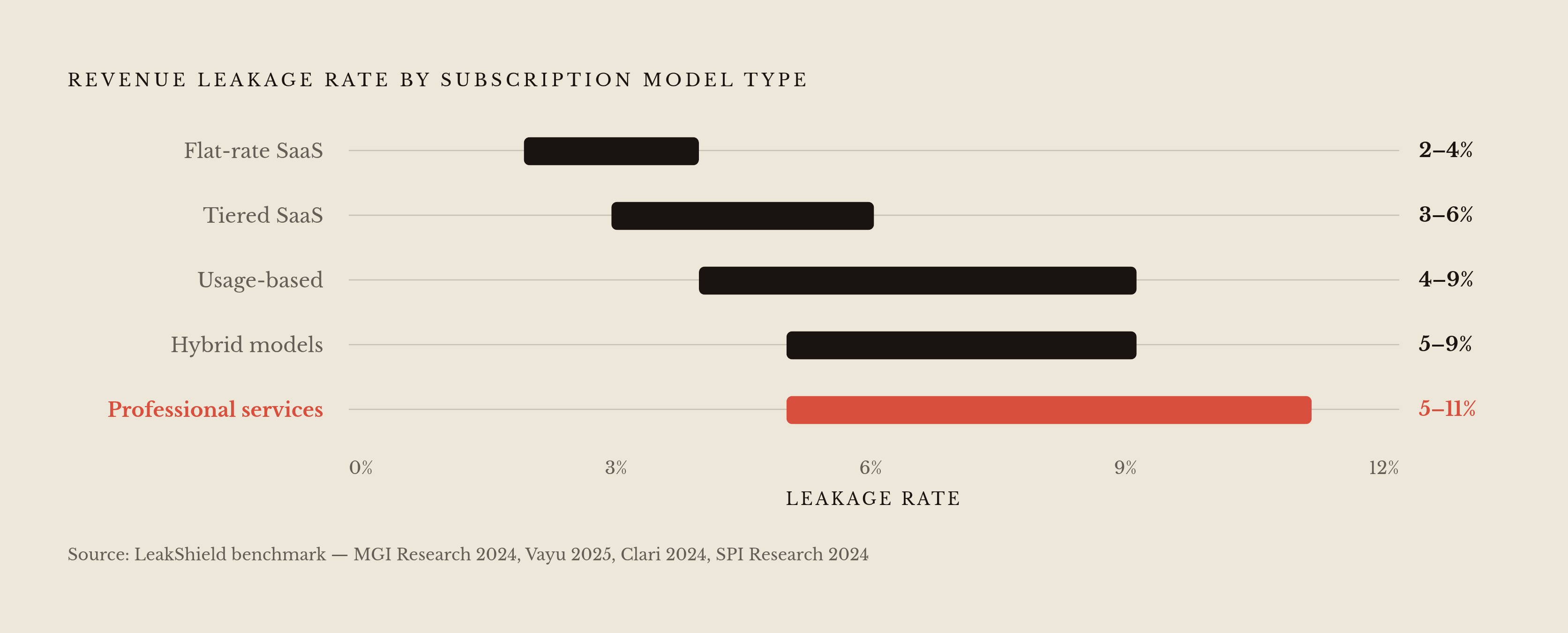
Start with the numbers everyone already tracks, because they're not small. Subscription businesses lose leakage at rates that scale with complexity: flat-rate SaaS is 2-4%, tiered SaaS climbs to 3-6%, usage-based models run 4-9%, hybrid models hit 5-9%, and professional services top the list at 5-11%, the LeakShield benchmark shows, drawing on MGI Research 2024, Vayu 2025, Clari 2024, and SPI Research 2024.
MGI Research's 2025 numbers: leakage eats 1-5% of EBITDA every year, which for a mid-size company means somewhere between $500,000 and $5 million disappearing quietly inside revenue streams that look healthy on the surface. Poor contract management alone costs the average business 9% of annual revenue, according to WorldCC research; the best-run companies hold that down to about 3%, while the worst lose as much as 15%. EY's Revenue Assurance study found 42% of CFOs call this leakage systematic, not accidental, tracing it to structural gaps between billing, CRM, and contract systems. The LeakShield benchmark identifies pricing and billing configuration errors as the single biggest category, at 38%.
The math on valuation gets uncomfortable fast. At a median SaaS revenue multiple (Bessemer Cloud Index, Q4 2025), every dollar in leaked revenue destroys several times that amount in enterprise value. That's real money, and it's the kind finance teams already know how to hunt.
But here's what none of those figures capture: the deals that never make it to a contract at all, because the buyer stopped trusting the story somewhere around the third sales call.
Where messaging enters the leak, the narrative dimension of execution gaps
Applying SpurIQ's execution-gap framing to a sales conversation makes the mechanism obvious. A rep pitches one value proposition. The website says something slightly different. The case study on the leave-behind deck references a feature that shipped under a different name eighteen months ago. None of these are lies, exactly. They're just... inconsistent. And inconsistency is what breaks buyer confidence, quietly, before anyone notices the deal has gone cold.
Pricing tells the same story from a different angle. When discounting authority and bundling logic live in one person's head, or scattered across three different messaging-app channels, reps end up guessing. They undersell. They discount without knowing if they're allowed to. Research from Strategic Pete on marketing bottlenecks points to structural causes across the funnel: unclear value propositions, scattered calls-to-action, and follow-up that depends on who happens to be free that week.
That distinction matters more than it sounds like it should. Training fixes an individual rep's delivery. It cannot fix the absence of a single governing version of the company's story, because there's nothing consistent to train reps on in the first place. Revenue leaks across the whole customer journey this way, not inside one department. Marketing generates a message that doesn't quite land. Sales responds to it inconsistently, because there was never a shared script to begin with. Limited capacity leads to rushed messaging, rushed messaging tanks conversion, poor conversion pulls budget toward the next campaign instead of fixing the last one, and reps get pushed to improvise even more. The cycle repeats, quietly, at the expense of whoever's quota is due this quarter. It just repeats, quietly, at the expense of whoever's quota is due this quarter.
Why calling it a training problem misses the structural cause
Most companies respond to messy messaging the way they'd respond to a leaky faucet: patch it, don't replace the pipe. New playbook. Refreshed deck. A two-hour enablement session that everyone forgets by Friday. These interventions treat the symptom, and they treat it at the individual level, which is exactly the wrong altitude.
Playbooks go stale the moment the market shifts, and without something governing them, every update is a one-off patch rather than a fix. Worse, when marketing, product, and sales each keep their own version of the company's story (and they usually do), the playbook only ever captures one team's dialect. New reps then onboard into whatever version of the story happens to be locally dominant on their team, which may have nothing to do with what the enterprise buyer across the table already read on the website last week.
These problems persist because there's no shared framework for evaluating priorities or making trade-offs. Each team optimizes for what makes sense in its own little bubble. Nobody's wrong, exactly. They're just solving different puzzles.
Technical debt makes the mechanism concrete. Deloitte's 2026 Global Technology Leadership Study found technical debt eats 21-40% of total IT spending, money spent servicing old decisions instead of building new value. Protiviti's 2025 Global Technology Executive Survey put the average at 30% of IT budgets. Language debt runs on the same logic: sales, marketing, and enablement budgets get consumed by compensatory content creation, retraining cycles, and deal-rescue scrambles, which are just symptoms of language nobody's governing.
Reporting on Siri's internal state offers the sharpest analogy available. Internally, Siri was described as a patchwork, old rule-based components stitched to newer generative models, with core features working only 66-80% of the time. A company whose pitch deck, website, and analyst briefings were each written by a different team, at a different time, with no shared framework, produces that exact same patchwork in front of buyers. The fix is building the foundation. It's building the foundation. That's what narrative infrastructure means, in practice, not as a metaphor.
What narrative infrastructure is and what it governs
Narrative infrastructure is the system that decides who controls the canonical language, how terms get defined and kept current, and how decisions about that language move across departments without every team reinventing it. It's the system that decides who controls the canonical language, how terms get defined and kept current, and how decisions about that language move across departments without every team reinventing it from scratch.
Done well, it produces something close to organizational muscle memory: the ability to make strategically consistent calls at every level, adapt to new situations without losing the thread, and balance competing priorities on purpose instead of by accident (in practice).
Three things have to be in place for that to work. First, a canonical document layer, the single authoritative version of the company's story, its competitive position, and its vocabulary, that every deck, email, and sales call draws from. Second, a propagation mechanism: a way for that canonical language to actually reach sales conversations, product marketing, onboarding, and renewal calls, functioning as a live operational system rather than a PDF nobody opens after week one. Third, a governance rhythm, someone accountable for keeping that canonical layer current as the product changes, the market shifts, and competitors start saying something new.
Language decisions, in this sense, work like architecture. They're expensive to walk back once other decisions get built on top of them, the same way an early technical architecture choice becomes expensive to unwind five years later. Encode the narrative into how the organization actually runs, and information starts flowing in a way that reinforces strategy on its own, without someone standing over every team's shoulder to keep the story straight. For a B2B company, a governing layer, call it a Narrative OS, defines the canonical language, keeps it current across every function, and flags when the story has drifted from what's actually true or from what the market needs to hear now instead of eighteen months ago.
How AI amplifies narrative fragmentation before it fixes anything
Large language models don't store a fixed, agreed-upon definition of any brand. They build one from patterns, scraped across websites, reviews, media coverage, forums, and social posts. Meltwater's research on LLM brand visibility calls the result "narrative drift": inconsistent messaging across channels leads AI tools to generate descriptions that are vague, outdated, or flat wrong.
Hootsuite's research on LLM visibility breaks the problem into four layers: presence, positioning, sentiment, and narrative gaps, where the gaps are whatever the AI leaves out or gets backwards. An old limitation can appear in a summary as though it's still true today, and most buyers never think to double-check it against the source.
Scale makes this worse, not better. The global LLM market is projected to grow substantially from 2025 to 2026, and Stanford's 2026 AI Index found generative AI reached 53% of the global population. That means for most of the addressable market, the first encounter with a company's story now runs through an AI system, not a human reading a website line by line. The nature of LLM training means a bad or inconsistent signal doesn't just mislead one reader. It can shape the outputs a model generates for millions of future queries, an effect a single bad social post never had.
The sales consequence is direct. Without consistent signals across media, analyst coverage, and executive content, reps lose the ambient credibility that used to lower the cost of starting a new conversation. Every deal starts from zero instead of building on something the buyer already half-believes. And the market is already pricing this in: AI citation tracking is emerging as a growing priority in brand budgets, while traditional brand-tracking surveys are stalling out. AI doesn't repair a fuzzy narrative. It photocopies it, at scale, forever.
What revenue recovery requires (and what it rules out)
What doesn't work is tempting and it's everywhere. New sales decks bolted onto a fragmented story. AI tools trained on inconsistent source material. Enablement programs built to teach a canonical story that doesn't exist yet. All three are the narrative equivalent of paying 30% of an IT budget just to keep old debt from collapsing, instead of ever building anything new.
Recovery takes three steps, and none of them are optional if the other two are going to hold. Audit first: map every channel where the company's story currently lives, website, pitch deck, email sequences, analyst briefings, case studies, renewal conversations, and find every place the language contradicts itself. That divergence is the diagnosis. Canonicalize next: build one governing narrative document, not a brand guide, not a messaging matrix, but an architectural decision about what the company actually is, what problem it owns, what vocabulary the category runs on, and what every buyer-facing surface pulls from going forward. Govern last: name who owns that canonical layer, what triggers a revision, and how updates actually reach every team that needs them, the same discipline already applied to technical systems, just pointed at language instead of code.
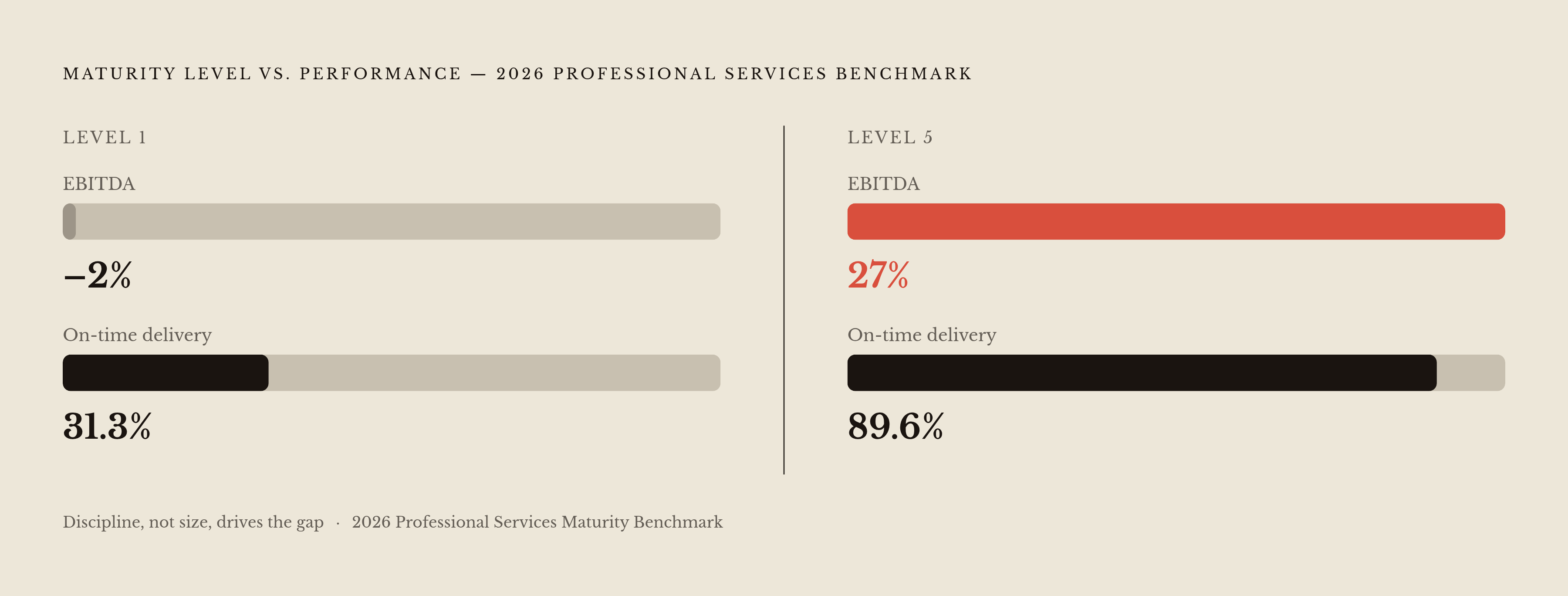
The 2026 Professional Services Maturity Benchmark makes the stakes concrete. High-maturity firms (Level 5) post 27% EBITDA and hit on-time delivery 89.6% of the time. Level 1 firms post -2% EBITDA and hit on-time delivery only 31.3% of the time. Discipline, not size, causes that gap, and the same gradient is visible in how well a company governs its own story.
Fast-scaling companies feel this hardest. Every new rep, every new market, every new product tier adds another surface where the story can drift a little further from itself, and the canonical layer is the only thing that stops that drift from compounding. Companies deploying AI across go-to-market functions feel it even sooner: the canonical narrative is the raw material the AI runs on, not a nice-to-have sitting next to the AI tooling. Fed a fragmented story, it hands back a fragmented story to every buyer who asks, just faster.
Revenue leakage from inconsistent messaging is language debt. It's language debt. Like technical debt, it compounds, quietly, until somebody finally builds the infrastructure it was missing all along. It just compounds, quietly, until somebody finally builds the infrastructure it was missing all along.
Sources
- Revenue Leakage in SaaS: How to Find It, Measure It & Stop It
- Marketing Bottlenecks: 10 Problems Stalling Growth
- 2026 Professional Services Maturity Benchmark | Rocketane
- What Is Revenue Leakage? Causes & How to Stop It in 2026 | SpurIQ
- leaksshield.com
- How can I prevent customer downgrade revenue leaks?
- blog.hootsuite.com
- meltwater.com