
FDA Enforcement Risk From Inconsistent Product Language in Life Sciences
FDA enforcement in life sciences rarely comes down to one bad claim on one bad day. It comes down to language drift, the gap between what a company's regulatory submission says and what its sales decks, websites, and reps say out loud, and that gap is what turns into legal evidence against them. Narrative consistency across every channel a company touches is a compliance requirement with criminal exposure attached, not a nice-to-have for the marketing team.
How FDA determines intended use
FDA does not decide what a product is for by reading the regulatory filing alone. It reads everything the company has ever said about the product, from the label to the website to the sales script, and treats that whole pile of language as one piece of evidence. The rule behind this is 21 C.F.R. § 801.4, and it says intended use gets established by the "net impression" left by labeling, advertising, rep statements, and the circumstances surrounding how the product gets sold and used.
That means a cleared 510(k) or an approved drug label sets the floor, not the ceiling. Nothing stops a marketing claim on a website from expanding that floor into territory the FDA never reviewed or cleared, and no new filing has to happen for that to count. A single disease-related claim, dropped into a sales deck or a podcast interview, can be enough on its own to establish a medical purpose and pull a product into device classification requirements it was never built for. The bar here sits low, and FDA looks at the whole body of language, not just the worst sentence in it.
This matters because the FFDCA is a strict liability criminal statute. Misbranding and unauthorized intended use are not administrative paperwork problems that get fixed with a phone call. Nobody has to prove the company meant to mislead anyone. The mismatch itself is the violation, regardless of what anyone intended when they wrote the copy. Every channel a company operates, its website, its app store listing, its rep talking points, its executive's guest spot on somebody's podcast, becomes part of one evidentiary record in FDA's eyes. When a company treats each channel like a different conversation with a different audience, it builds the exact pattern FDA has spent the last two years hunting down.
Why language drift across channels sets off enforcement
The enforcement actions from 2025 into 2026 follow one shape: different products, same violation. Language in one channel contradicts or stretches past the language in the regulatory submission, and that contradiction is the violation. The product itself, the science behind it, usually has nothing wrong with it. What got said about it somewhere FDA could see is the problem.
FDA's 2025 enforcement sweep touched manufacturers, online retailers, clinics, telehealth providers, and compounding pharmacies. These companies had almost nothing in common on paper. Different products, different business models, different sizes. The warning letters had nothing to do with product type, they all turned on promotional language that ran past the scope FDA had actually cleared or approved. The Covington year-in-review covering 2025 documents OPEQ issuing warning letters to device manufacturers both for marketing devices without the clearance they needed and for rolling out changed indications for use in their promotional materials without filing the new 510(k) premarket notification that change required.
The channels doing the damage keep expanding, too. Websites, social media accounts, online storefronts, and podcast appearances have all shown up as the evidence behind a warning letter, and this counts as a standard part of how FDA builds its case now, not some rare exception. In one documented instance, FDA pointed to a podcast interview where a company's executive chairman and global chief scientific and medical officer made statements on a YouTube show, The Sean Spicer Show, that FDA read as promotional claims about the product. Nobody wrote those words into a label. Someone said them out loud on a podcast, and FDA treated that the same as if they'd printed it on the box.
The pace didn't let up once 2025 ended. The first quarter of 2026 produced another round of warning letters and untitled letters spanning drugs, devices, and biologics, which confirms this is a sustained posture FDA has settled into, not a short-term campaign that will quietly wind down. Companies drift into trouble the same way a boat drifts off anchor: nobody decides to do it, the current just pulls a little at a time until the gap between where you're supposed to be and where you actually are is too wide to ignore.
Four documented cases where the channel gap became the warning letter
Four cases from 2025 show this same mechanism at work, even when the products, companies, and channels have nothing in common. In each one, a company kept one version of its language in the regulatory file and a different version everywhere else, and FDA treated that difference as proof of an intended use nobody had filed for.
DRG Instruments GmbH got a warning letter in March 2025 over its Salivary Cortisol ELISA, a product labeled "Research Use Only." OPEQ alleged the product was actually meant for clinical diagnostic use, based on evidence an inspection gathered and pulled straight from DRG's own website. What made this case notable is how far FDA followed the trail: customer certification letters claiming research-only use fell apart once investigators checked those same customers' websites, which pointed toward clinical diagnostic testing. DRG's own site didn't help its case either. It carried a tab labeled "FDA Cleared Tests" listing devices DRG held no 510(k) clearance for, and it claimed FDA had reviewed and approved a product that was actually 510(k)-exempt. The language gap here wasn't subtle. It was a company telling customers one story and the internet a different one.
Rex Implants Inc. got its warning letter the same month, and the gap that triggered it was tiny by comparison, which is exactly the point. The cleared labeling for its dental implant system said the minimum buccolingual ridge width had to be 3.5mm. The Instructions for Use that actually shipped with the product said 3mm or more. One and a half millimeters, buried in a technical document most patients will never read, and FDA treated that as a major change to intended use requiring a brand-new 510(k) clearance. A single number mismatched between two documents was enough.
Exer Labs got a warning letter in February 2025 over AI-described functionality. FDA concluded that analyzing patient data for the purpose of screening and diagnosing specific conditions counted as a new intended use, which meant the device no longer qualified for the premarket notification exemption it had been operating under. Any company describing what its algorithm does in diagnostic or disease-specific terms needs to understand this case applies directly to them, regardless of how the underlying product was originally classified.
WHOOP's case, from July 2025, might be the most instructive of the four because it shows the limits of a defense a lot of companies assume will hold up. WHOOP marketed its "Blood Pressure Insights" feature as a wellness tool offering daily blood pressure estimates, explicitly positioned as nonmedical. At the same time, the company used language like "medical-grade health & performance insights" and made statements tying blood pressure to health conditions, including the line that higher blood pressure "may be an indicator of poor sleep." FDA's primary basis for the warning letter was that blood pressure measurement is inherently tied to diagnosing hypotension and hypertension no matter what disclaimer sits next to it, but the medical-grade language and the health-condition statements reinforced that determination. The case resolved after WHOOP changed the product and its labeling, and after FDA's updated wellness guidance in January 2026 opened a pathway for non-invasive blood pressure features used for wellness purposes. WHOOP still had to make product changes as part of that resolution. The warning letter itself stands as proof that calling something "wellness" doesn't automatically protect it. The intended use FDA recognizes is the one the language creates, not the one the product team had in mind when they built it.
Financial Exposure: The False Claims Act and the Escalation Ladder
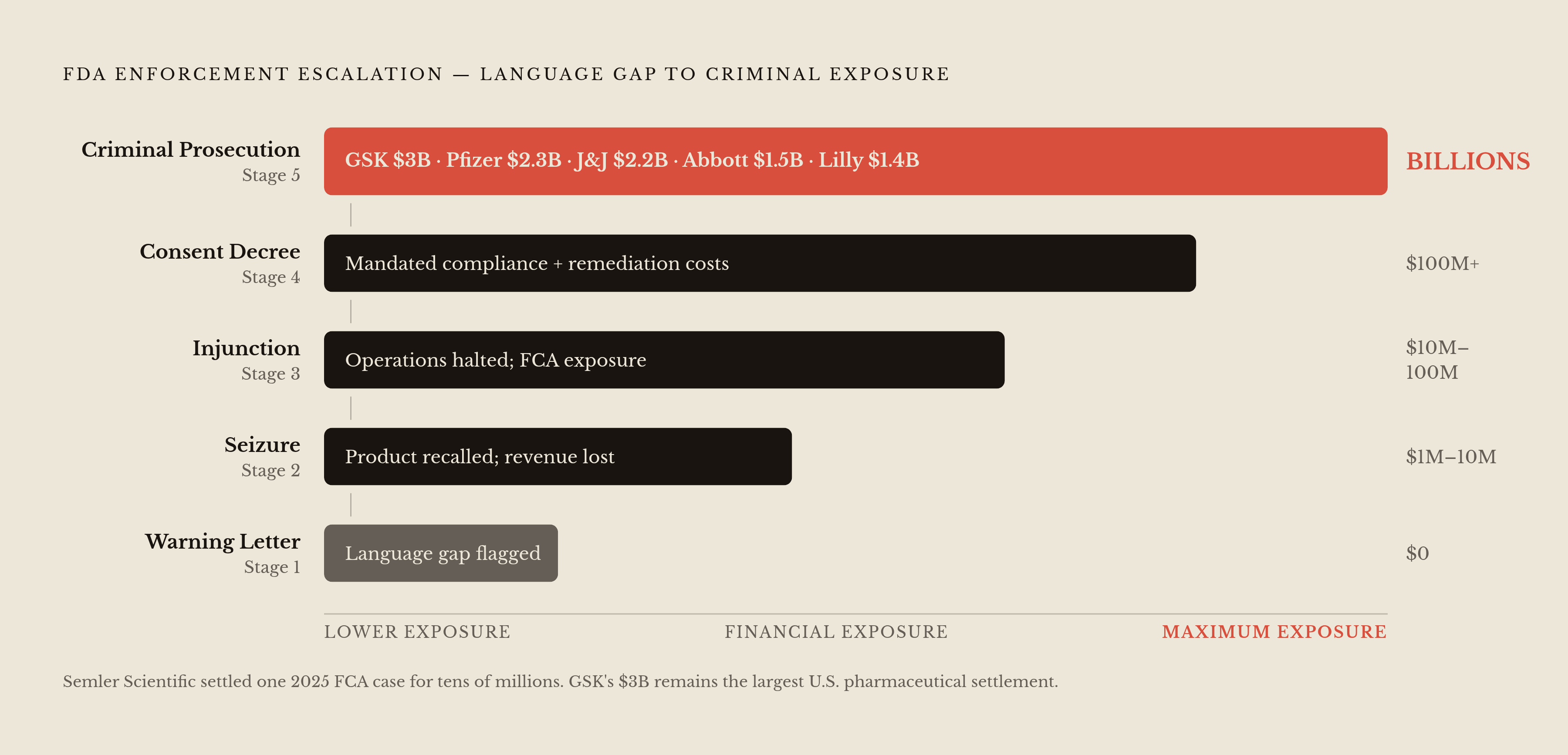
A warning letter is where the exposure starts, not where it ends. If promotional language causes a physician to prescribe or use a product for a purpose FDA never approved, every reimbursement a federal healthcare program pays on that prescription can count as a false claim under the False Claims Act.
Medicare and Medicaid generally won't reimburse for off-label use unless that use appears in a recognized compendium, and that rule is what creates the mechanism. When off-label marketing drives prescriptions that then get submitted to a federal program for payment, the gap between what got cleared and what got promoted becomes the legal basis for a false claim. That's the same language gap from the warning letter cases above, just further downstream, where it turns into a different and much larger category of liability.
Whistleblowers have real financial reasons to report this gap. The FCA lets individuals who expose off-label marketing fraud collect a share of whatever the government recovers, so if a sales rep, distributor, or employee notices the promotional language doesn't match the regulatory filing, they have a financial incentive to say something. That turns a company's own sales force into a built-in audit risk.
Once a warning letter goes unaddressed, the path forward runs through seizure, injunction, consent decree, and criminal prosecution. Companies that don't correct course after that first letter face direct legal intervention, not another round of polite correspondence. The size of the numbers at the top of this ladder is well established. GlaxoSmithKline's settlement, the largest in U.S. pharmaceutical history, included off-label promotion charges, and Pfizer, Johnson & Johnson, Abbott, and Eli Lilly have each resolved FCA allegations for sums running into the billions. At least four False Claims Act cases resolved in 2025 relied on allegations tied to marketing FDA-cleared or approved products for unauthorized uses; in one, Semler Scientific and a former distributor agreed to pay a combined total in the tens of millions to resolve claims that they marketed their FloChec and QuantaFlo devices as digital ankle-brachial index products without clearance for that use. Pfizer separately paid close to $60 million to resolve allegations that its subsidiary Biohaven violated the Anti-Kickback Statute and the False Claims Act by giving physicians speaker honoraria and meals to drive prescriptions of its migraine medication. That case matters here because it shows the exposure isn't limited to a bad sentence on a website. It extends to how the entire promotional system gets built, who gets paid, what they're told to say, and where the incentives point. If that same small gap gets a company a warning letter, it can turn into a nine-figure settlement several steps later.
The 2026 regulatory environment and language governance
Companies that treated the 2025 enforcement surge as a one-time event, a storm that would pass, are reading the situation backward. The conditions that drove that surge haven't eased up going into 2026. They've gotten stronger.
The pace hasn't dropped. By the first quarter of 2026, CDER's OPDP had already issued nine untitled letters and one warning letter, APLB had posted four untitled letters covering biologics, and OPEQ had issued three device warning letters. Nothing about the start of a new year slowed any of it down.
Guidance itself has gotten less stable, and that instability creates its own risk. The January 2025 "One-in-Ten-Out" Executive Order puts long-standing draft guidances at risk of withdrawal with little warning, including guidance covering how to present risk information, how to respond to off-label requests, and how to handle postmarketing submissions for interactive media. If a company built its promotional review process around those guidances, it may find the ground underneath it has moved without notice. On top of that, OPDP's Division of Promotion Policy, Research, and Operations was eliminated in April 2025, which cuts into FDA's ability to issue new guidance and slows down advisory comment timelines. Advisory review used to function as a pre-enforcement checkpoint companies could lean on. That checkpoint is weaker now.
Digital health products built around AI-generated outputs now sit in a position that's newly defined but still demanding. FDA's updated General Wellness guidance, released in January 2026, widens the pathway for low-risk products, but a product's intended use and claims still have to stay inside the wellness-only boundary. If the language drifts one sentence into clinical-sounding territory, the product steps outside that safe harbor. FDA's new unified Adverse Event Monitoring System, announced in March 2026, adds real-time adverse event data across product categories, so when a performance issue shows up alongside promotional language that doesn't match the file, the faster safety-signal pipeline it builds could speed up enforcement timelines. And the list of channels FDA treats as evidence keeps growing. Podcasts, influencer content, and social media are all documented sources now, so every channel that carries a company's language is one FDA might read closely. You can't wait for clearer rules before you tighten language practices anymore. The rules keep moving, and the enforcement keeps coming regardless.
What language governance requires at the operational level
Closing that gap starts with treating every public-facing channel, not just the regulatory label, as part of one connected record that has to match. A sales deck, a website FAQ, a rep's talking points, and a CEO's podcast appearance all need to trace back to the same cleared or approved language, because FDA will read them that way whether a company plans for it or not. Building that kind of consistency means someone has to own the comparison between what the filing says and what every other channel says, on an ongoing basis, not as a one-time audit before a product launch.
It also means treating marketing and regulatory as one team rather than two departments that occasionally forward each other emails. The Rex Implants case shows how a single number buried in an Instructions for Use document created an enforcement basis on its own, so review processes need to catch small numerical and descriptive details, not just the big promotional claims that seem risky on their face.
Companies building AI-adjacent products need language scoped to avoid diagnostic or disease-specific framing unless they've actually filed for that use, because the Exer Labs case shows FDA will reclassify a product based on how its outputs get described, no matter what the underlying technology is. Wellness-positioned products need the same caution. WHOOP's case shows that wellness framing doesn't protect a product if medical-grade claims or condition-linked statements undercut that framing elsewhere on the same page or in the same app.
Given how unstable FDA guidance has become, companies can't treat a single compliance review at launch as sufficient. Draft guidances can get pulled with little warning, and advisory review channels have grown slower since OPDP's policy division was eliminated in April 2025, so language governance needs to run as a recurring process, one built to catch changes in the regulatory floor before FDA catches them first. Whoever runs this process also needs visibility into every employee-facing channel, since FCA whistleblower incentives mean any sales rep or distributor who notices a mismatch between the label and the pitch has a financial reason to report it, and that reporting can trigger exposure that runs far beyond a warning letter. Consistency between what gets filed and what gets said has stopped being a writing preference for the marketing team. It functions as the actual compliance boundary FDA is already measuring companies against.