Cross-Functional Language Misalignment Between Legal and Product Teams
Both teams grade the same words against invisible scorecards only they can see.
Take a single clause: "99.9% uptime." Four words, one decimal point, and two departments who would swear under oath that they agree on what it means. They don't: to the team that wrote the product description, it's a marketing promise, a number that sounds confident on a sales call. To legal, it's a measurable commitment with a definition of "downtime" attached, a penalty structure, and a two-year shelf life during which someone might sue over it. Same four words. Two different documents wearing the same outfit.
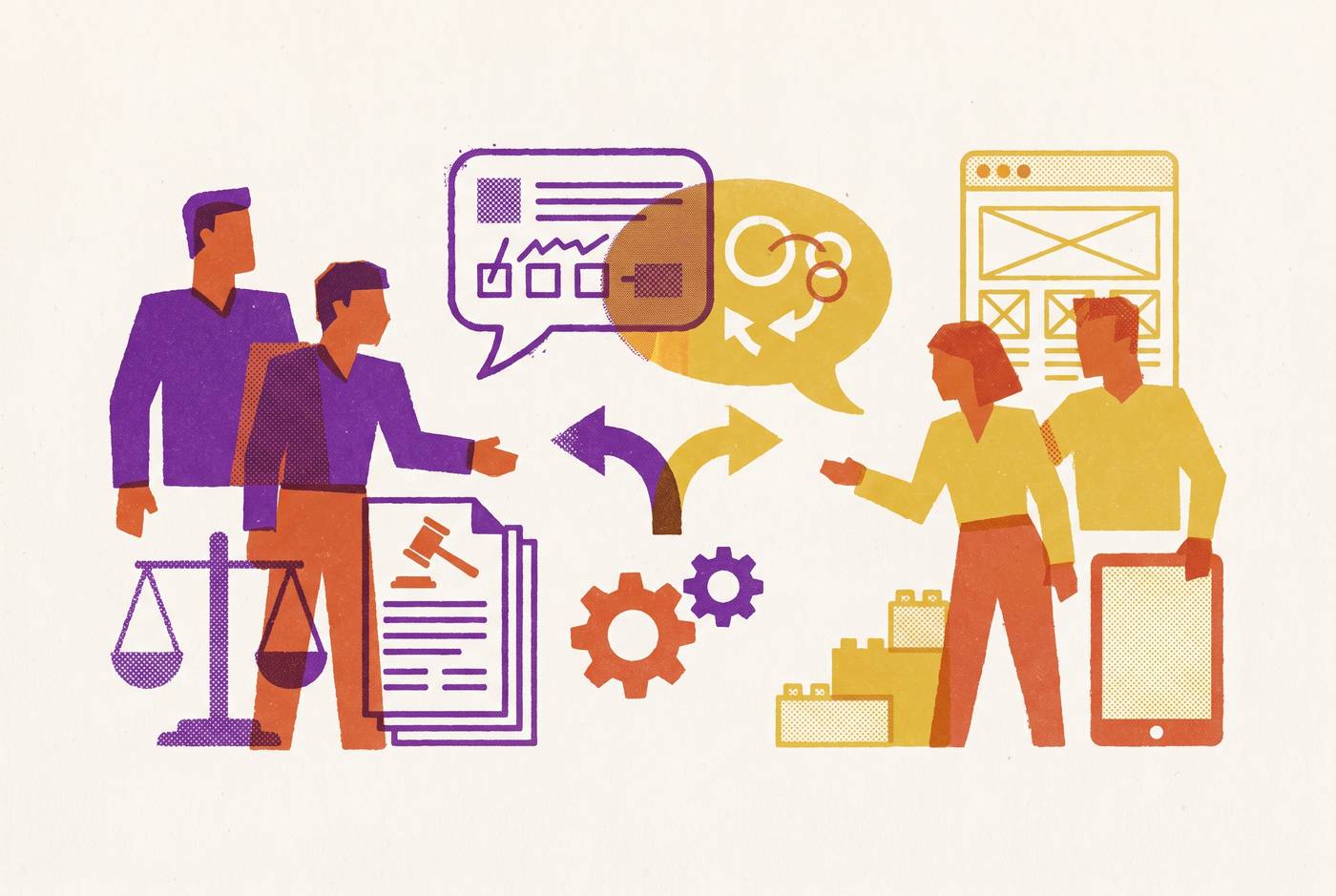
That split is not a tone problem. Brand and product teams optimize for market impact and launch date. They want the sentence that sells. Legal optimizes for claim substantiation, IP exposure, and defensibility long after the launch party is over. Those are two different jobs with two different scoreboards, and when both teams touch the same sentence, they're each grading it against a rubric the other team has never seen.
Calling this a communication problem is like calling a car crash a "scheduling conflict." Better meetings won't fix it, and neither will a team offsite with a trust fall. What's missing is a canonical source of record, something both functions can point to before anyone writes the clause, names the product, or promises the uptime number in the first place, so that legal and product are collaborating instead of co-authoring two different documents that happen to share a font.
How the same artifact accumulates incompatible meanings across functions
The divergence doesn't arrive at the end of a project like a surprise invoice. It gets built in, piece by piece, at every handoff along the way. Product writes a line. Marketing sharpens it. Legal redlines it. Sales simplifies it again for the deck. By the time the sentence reaches a customer, it has been translated through four vocabularies, and nobody checked whether the translations still say the same thing.
Product naming is where this plays out in public, repeatedly and expensively. Most B2B naming efforts turn into subjective word games, rounds of "does this feel more innovative or more trustworthy," right up until legal kills the favorite at the eleventh hour over a trademark conflict nobody flagged earlier. A standard naming project can run four to twelve weeks. Complex enterprise naming projects often stretch to ten to twelve weeks or more, and the delay has nothing to do with how clever the name is. It comes down to the number of stakeholders in the room and the depth of the trademark clearance process, both of which exist because nobody agreed on the ground rules before the brainstorm started.
The uptime clause is the same failure wearing a different costume. If engineering and legal haven't agreed, long before a term sheet lands on the table, on what uptime the infrastructure can actually support and document, that gap becomes a contractual default risk baked into the deal. It doesn't surface once and go away. It resurfaces at every renewal, because the original ambiguity never got resolved, just re-signed.
Why the gap compounds as organizations grow
Language misalignment behaves like debt. It charges interest. At thirty people, a fuzzy definition of "enterprise-grade" is an annoying back-and-forth in a team chat. At three hundred people, it's a structural fault running under three different product lines. Past a certain scale, the fault becomes the culture itself, the water everyone swims in without noticing they're wet.
The mechanism is straightforward: cross-functional teams don't fail because the people in them are bad at their jobs. They fail because each person was trained by their home department to optimize for a different goal, and nobody ever handed them a shared definition of success. Every meeting becomes a quiet negotiation, conducted in two vocabularies that were never built to translate into each other.
What makes this expensive is how well it hides. Misalignment disguises itself as other problems. A missed launch gets blamed on engineering being slow. A stalled deal gets blamed on a soft market. Talent walking out the door gets blamed on compensation. The actual cause, that the organization never built a shared language, is usually the last explanation anyone tests, mostly because it doesn't look like a cause. It looks like the water.
Research cited by Narratize found that product development consultancies report eight-month projects that require a complete rework because the teams were never aligned from the start. The rework cost doesn't appear eight months in. It was there on day one, quietly compounding, waiting for someone to notice.
Where the cost surfaces in deals and go-to-market velocity
The abstraction turns into a number a CEO actually tracks, deal velocity, once enterprise buying groups evaluate a vendor. They evaluate simultaneously, with finance, IT, and legal all reading the same materials against entirely different success criteria. The champion wants features. Legal wants risk contained. Finance wants the math to work. When the product pitch describes a capability one way and the legal terms describe the same capability another way, the buyer doesn't read that as normal variation between two kinds of documents. They read it as a warning sign.
The symptom appears in small, deniable increments. An NDA sits for three days longer than it should. A vendor agreement spends a week in a queue nobody's actively avoiding. A general counsel ends up explaining to the board why legal is the reason a deal slipped an entire quarter. None of these moments look like a crisis on their own. Stacked together, they're a pattern, and the pattern has a name: structural misalignment wearing a calendar as a disguise.
The deck ran 24 slides, and on slide 2, over a full-bleed photo tagged #shifthappens, sat the line: "We now live in a subscription economy." That single sentence became the organizing frame for an entire go-to-market motion, cited by CFOs, CIOs, and product leaders alike. One canonical phrase did the work of category creation, because everyone touching the deal, across every function, was speaking from the same sentence.
AI Raises the Stakes on the Shared Language Layer
AI does not fix a vocabulary problem. It photocopies one, at scale, with a straight face. A large language model has no independent opinion about what "enterprise-grade" means inside a given company. It only knows what the organization's own documents tell it, and if those documents disagree with each other, the model will cheerfully generate output that disagrees with itself too.
That's the mechanism in plain terms: an AI system trained or prompted on a fragmented corpus doesn't average out the fragmentation into something coherent. It reproduces it, confidently, across more documents and more conversations than any single team of humans could generate in the same stretch of time. Feed it a legal definition of uptime and a marketing definition of uptime, and it will hand back both, polished and persuasive, with no flag that they contradict each other.
The exposure that creates isn't theoretical. A company that hasn't closed its internal legal-product vocabulary gap before deploying AI walks into enterprise deals carrying contractual default risk at precisely the moment buyers are reading every definition with a magnifying glass. The AI didn't cause that risk. It just made sure it showed up faster, in more places, and in writing.
What a shared language layer actually requires and what it is not
A shared language layer is a canonical source of record, not a style guide or a workshop where legal and product spend an afternoon building empathy over sticky notes. Those things might feel productive, but they don't survive contact with the next contract renewal. A real fix looks more like an operating system: a canonical source of record that both functions treat as authoritative, built before artifacts get produced and maintained across their entire lifecycle, not patched in after the damage is done.
The discipline starts with something almost embarrassingly simple: writing things down. Conversations feel like alignment while they're happening. Documents are what reveal whether the alignment was ever real. The test is how often a written summary of an "agreed" plan comes back from the other side marked "that's not what I said." If that happens constantly, there's no canonical record, there's just a shared memory of a meeting, and memories edit themselves.
A working version of this layer has recognizable parts. There's a standardized glossary covering product terminology, process language, and key performance indicators that both legal and product sign off on, so "enterprise-grade" means one thing, in one place, for everyone. There are standardized contract templates with legal and business approval built into the starting point of the lifecycle, rather than bolted on after the fact, closing the gap where inconsistent language between contracts quietly creates inconsistent obligations. There's a shared decision log and a common triage vocabulary, the kind one general counsel built by borrowing IT's P0/P1/P2 framework to give the business a shared way to talk about urgency, replacing gut-feeling language with agreed terms everyone could point to. And there's a contract playbook that legal leads but doesn't write alone, because sales, procurement, and finance all have to be in the room. A playbook legal loves and commercial teams ignore isn't a playbook, it's a binder.
Narratize's alignment research names the underlying failure with uncomfortable clarity: knowledge fragments across tools, teams, and time, so when a product manager needs to understand a technical constraint, the answer exists somewhere. It's just locked behind three separate meetings to extract it. A canonical layer doesn't create new knowledge. It makes the knowledge that already exists retrievable at the moment someone actually needs to use it.
How to diagnose whether your organization has a language layer or just the illusion of one
Most organizations believe they're aligned because they've had the meetings and produced the documents to prove it. The real test is narrower and far less comfortable: would legal and product give the same answer, independently, with no chance to compare notes first, to five specific questions?
Can legal and product each produce, without consulting each other, the same uptime number and the same definition of downtime for the product sales is pitching this week? When someone describes a feature as "enterprise-grade," do both functions mean the same thing by it, and is that meaning written down anywhere either of them could cite? If a customer asks whether their data trains the underlying model, would legal and product answer using the same language, or just the same confidence? Does a new product name clear legal before it ever reaches a pitch deck, or does legal meet it for the first time already signed into a term sheet? And when legal flags something as urgent, does product understand what threshold of urgency that word is carrying, in both directions?
A "yes" to these questions usually means "we talked about it once," not "we have a canonical record of it." That distinction is the whole diagnostic. Misalignment hides well, and the only way to catch it is to force an answer onto paper and see whether the two versions match.
The scale warning holds here as a closing fact, not a flourish. At thirty people, failing these questions is friction. At three hundred, it's structural. Past that, it becomes culture, embedding itself into how every new hire gets onboarded. The cost of building the canonical layer later only grows with every person who learns the old, fragmented language before anyone teaches them the shared one.