
Whistleblower and Employment Litigation Risk From Ambiguous Policy Language
Ambiguous policies invite courts to read them against employers in whistleblower retaliation cases.
Whistleblower litigation risk is a language problem more than a conduct problem. When your handbooks, NDAs, and escalation procedures leave room for interpretation, courts and juries fill that gap. They fill it in the employee's favor, every time.
Why whistleblower claims are an interpretive problem as much as a compliance problem
The California Court of Appeal handed down a ruling in December 2025 that should make every employment counsel pause. In Contreras v. Green Thumb Produce, Inc., the employee's retaliation claim survived even though his legal interpretation of the Equal Pay Act was wrong. The court held that section 1102.5(b) requires only that the employee have "reasonable cause to believe" a violation occurred. Being legally correct was never the standard.
What made the belief reasonable? The ambiguous language in the California Labor Commissioner's own FAQ document. It omitted protected class language in several sections, which could have reasonably misled a layperson. So an employee read a government document, drew a wrong conclusion, got fired, and still had a viable retaliation claim. That's the interpretive gap in action.
The implication for employers is uncomfortable. If official regulatory language can produce a valid retaliation claim even when legally mistaken, your internal policy language carries at least as much exposure. Your handbook is probably not clearer than a government FAQ. And ambiguity is not a neutral drafting condition. It's a legal asset that transfers from the employer to the employee the moment a complaint is filed.
How broad the legal architecture of whistleblower protection actually is
Whistleblower protection in the United States is not a single statute. It's a dense, overlapping web of federal laws, each carrying its own definitions of protected activity, covered disclosures, and prohibited retaliation. OSHA and other agencies administer more than two dozen separate whistleblower statutes. The list runs from the Sarbanes-Oxley Act and Dodd-Frank to the Clean Air Act, Safe Drinking Water Act, FDA Food Safety Modernization Act, and the Surface Transportation Assistance Act. Each has distinct trigger language, covered employees, and remedies.
The Whistleblower Protection Act of 1989 covers most federal civil service employees. It protects disclosures that a covered employee reasonably believes evidence "a violation of any law, rule, or regulation" or "gross mismanagement, a gross waste of funds, an abuse of authority, or a substantial and specific danger to public health or safety." And the WPA prohibits retaliation across promotion, pay, removal, suspension, or any significant change in duties or working conditions.
In the private sector, the DOL's construction requires anti-discrimination provisions to be "broadly construed." Any action that would dissuade a reasonable employee from engaging in protected activity counts as retaliation, not only formal adverse employment actions. California adds another layer. Labor Code section 1102.5 protects internal reporting to supervisors and external reporting to government agencies. SB 497, effective January 1, 2024, created a rebuttable presumption of retaliation when an employer takes certain adverse actions within 90 days of protected activity. Your policy language has to function coherently across this entire surface area.
What "adverse action" now covers and why policy language about performance and reporting becomes evidence
Adverse action has grown far beyond termination. The DOL's broad construction means a policy shift, a new performance improvement plan, a reassignment, or even a change in who an employee reports to can constitute retaliation if it would dissuade a reasonable employee from making a protected disclosure. That expands the evidentiary universe dramatically. Vague language about performance expectations, reporting hierarchies, and confidentiality obligations doesn't have to be applied maliciously to create exposure. It just has to be applied after a complaint.
Here's the pivot point. The underlying complaint doesn't need to be valid for a retaliation claim to succeed. An employer can win on the substantive allegation and still lose on its response to the complaint. The Barclays case shows what this looks like at the manager level when escalation policy is unclear. The bank's CEO faced regulatory sanctions after trying to identify a whistleblower who sent anonymous letters containing allegations about a Barclays employee and the CEO himself. Ambiguous escalation procedures created the conditions under which a manager's response to a complaint became the violation.
The specific documents where language ambiguity most commonly opens the litigation door
The exposure concentrates in a predictable set of documents most organizations treat as boilerplate rather than legal infrastructure. Separation agreements and NDAs sit at the top of the list. The SEC's enforcement against Foot Locker, Inc. in May 2026 is the clearest example. Foot Locker paid a $148,000 civil penalty triggered by award-waiver boilerplate language in about 148 separation agreements. That's not deliberate suppression of reporting. It's a structural impediment through vague language alone.
Two unnamed investment advisers paid a combined $90 million to resolve charges that their separation agreements required nearly 300 departing employees to represent they had not filed complaints. The foundational precedent is KBR Inc. in 2015. Confidentiality agreement language warned employees they could face discipline, up to termination, for disclosing internal investigation interviews without prior authorization from KBR's legal department. Dodd-Frank Rule 21F-17 doesn't care about intent. It cares about language.
Employee handbooks are just as exposed. Vague performance standards, ambiguous reporting hierarchies, and undefined escalation procedures create the interpretive gap employees can exploit. When a manager applies these provisions after a complaint, the ambiguity makes the employer's intent impossible to prove. Compliance manuals and escalation procedures face the same problem. California Labor Code 1102.5 expressly covers disclosures to supervisors or others with investigatory authority, regardless of how the report is categorized internally. A government-accountability-office-confirmed chilling-effect mechanism adds another layer: overly restrictive NDAs that don't specify permitted reporting channels deter employees from raising concerns, even when the NDA isn't legally enforceable, and regulators treat that chilling effect as harm.
Why retaliation charges have become the dominant form of employment litigation and what that means for language risk
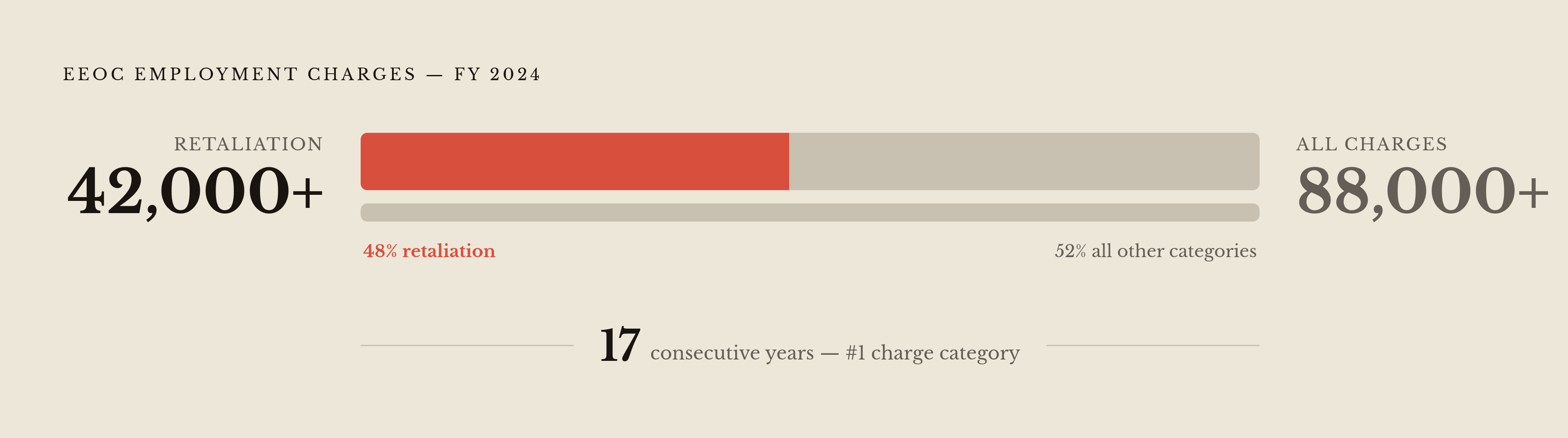
Retaliation is the most frequently charged employment violation in the country. It topped the EEOC's list for the 17th consecutive year in fiscal year 2024, accounting for more than 42,000 filings out of more than 88,000 total charges. That's the largest single category. The interpretive gaps in your policy language are being tested in court at an exceptional and sustained rate.
The financial stakes are concrete. In Valla v. Dignity Health Et Al., a single-plaintiff retaliation case decided in June 2025, a chief nursing officer was awarded $27.5 million. Her claim: she was terminated after raising patient safety concerns. One plaintiff. One case. The volume of claims means your policy language is not a theoretical exposure. It's tested regularly, in front of juries, in jurisdictions that award damages based on what a reasonable employee would have understood the language to mean. Retaliation claims don't require the underlying complaint to be valid.
How expanding state law and the UK Employment Rights Act 2026 are adding new categories and burden-shift rules that a single policy template cannot absorb
Multi-state and international employers running a single policy template are carrying compounded exposure. At least a dozen states have introduced or passed significant new whistleblower protections since 2023, with stronger anti-retaliation provisions, longer statutes of limitations, and higher damages. Several states have shifted the burden of proof so employers must affirmatively show adverse actions were unrelated to the report. California SB 497 made post-complaint management decisions presumptively retaliatory within 90 days unless the employer rebuts with clear documentation.
The UK's Employment Rights Act 2025, with significant provisions in force as of April 2026, added sexual harassment as a qualifying disclosure category. That removed the ambiguity that previously forced employees to argue their report fell under a breach of legal obligation. Whistleblowing protections apply even when complaints aren't labelled as whistleblowing. Informal handling, defensive responses, and poor separation between complaint management and discipline all create risk. The DOJ expanded its Corporate Whistleblower Awards Pilot Program in 2025 to include immigration-related violations, creating a financial incentive for individuals to report workplace immigration violations directly to the government. A policy template that's legally precise in one jurisdiction may be vague, non-compliant, or affirmatively misleading in another. The patchwork is actively growing.
Why federal SEC enforcement data creates a false sense of receding risk
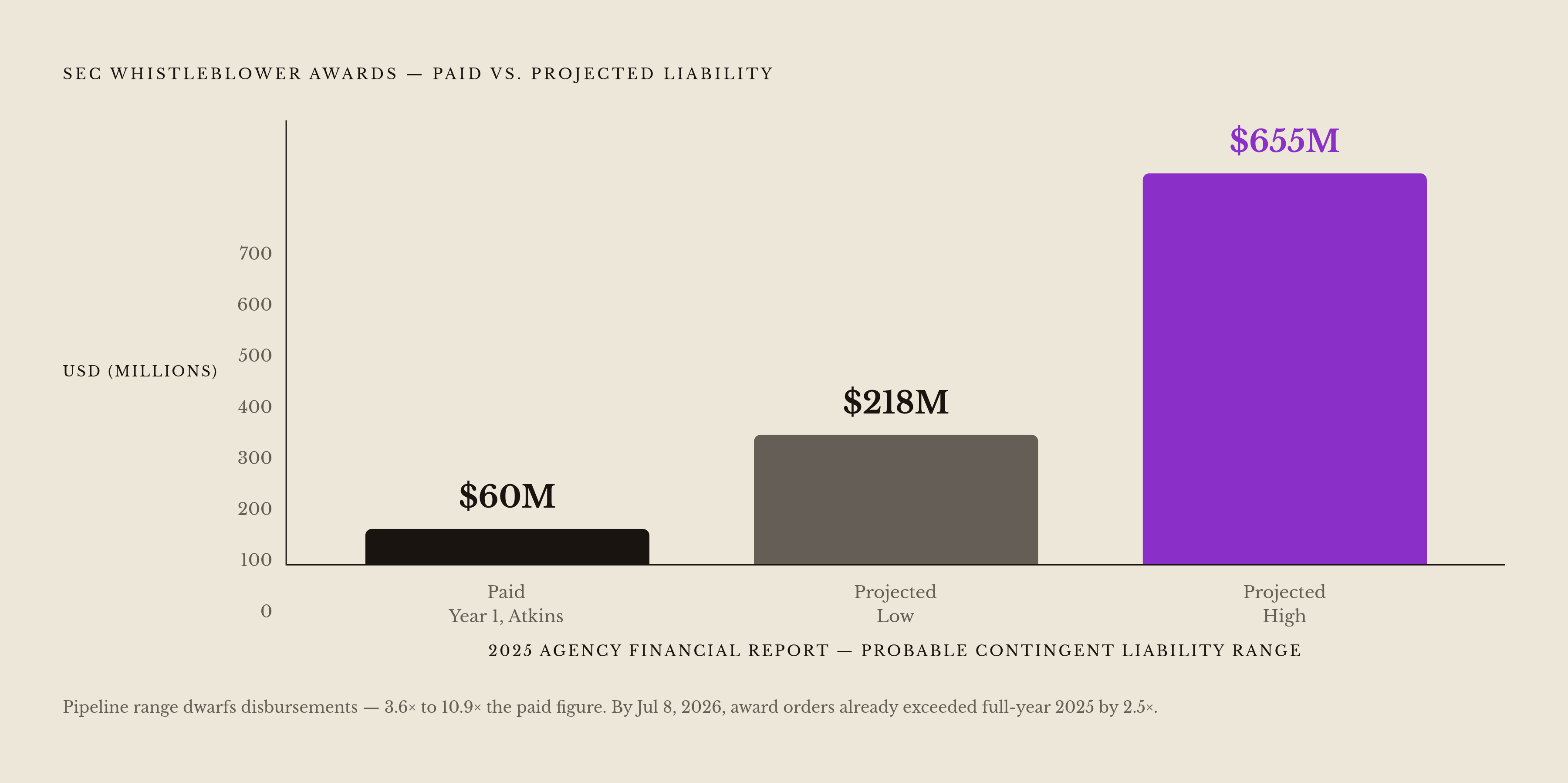
The apparent retreat of SEC whistleblower enforcement is a statistical artifact of timing, not a reduction in underlying exposure. In its first year under Chair Atkins, the SEC awarded whistleblowers only $60 million, down from $255 million in FY 2024. It also brought its fewest enforcement actions against public companies in a decade, about a third fewer than the prior year. Read as a compliance reprieve, that's a misreading.
The SEC's own 2025 Agency Financial Report set a range for probable contingent liabilities for whistleblower awards between $218 million and $655 million. That pipeline dwarfs the awards actually paid out. It indicates a backlog of claims, not a shrinking program. By July 8, 2026, the SEC had already issued more than two-and-a-half times the number of final award orders issued in all of calendar year 2025 combined. The rebound began before the year was half over. State-level enforcement is accelerating independently of federal trends. States aren't constrained by the current federal posture. Their expanded protections, burden-shift rules, and damages remedies mean multi-state employers can't use federal quietude as a proxy for overall risk.
How AI is amplifying whatever language an organization runs on — in both directions
AI doesn't create language risk. It scales it. On the employer side, AI is being used to draft handbooks, separation agreements, and compliance manuals at scale. A single flawed template clause that an AI system reproduces across hundreds of documents creates uniform, simultaneous exposure rather than isolated incidents manageable case by case. The Foot Locker case showed what boilerplate language does manually. AI does it at orders of magnitude. It's a feedback loop: AI tends to affirm the perspective it works from, so a flawed clause stays flawed, just more efficiently.
On the employee side, the machine cuts the other way. Employees using AI to build retaliation narratives produce polished, harder-to-dismiss documentation than ever before. The output is coherent, detailed, and internally consistent, regardless of factual accuracy. Employers face a growing volume of highly polished communications from employees building retaliation cases. An organization that hasn't governed its policy language can't govern the AI systems that reproduce and apply it. If you're unsure what your policies actually say, let alone how they read to a reasonable employee, that gap is about to scale.
Why precision without governance creates its own liability — and what the complete solution looks like
The strongest objection to the language-precision argument is that precise rules managers don't follow become evidence of pretext. It's a fair point. Vague language is a problem, but clear standards applied inconsistently are a different kind of exposure. If performance deficiencies aren't documented, juries treat the absence of documentation as evidence of retaliation. SHRM noted in July 2025 that the vast majority of jurors believe a company is negligent if it isn't documenting an employee's problems. The solution isn't precision alone. It's precision paired with consistent application.
The UK Employment Rights Act 2025 experience makes the governance point concrete. Whistleblowing protections apply regardless of whether a complaint is formally labelled as such. Informal handling, defensive responses, and poor separation between complaint management and subsequent discipline all create risk. Language in a policy document is only as protective as the manager behavior it produces. The complete solution has three interlocking components: precise, jurisdictionally calibrated language in handbooks, NDAs, separation agreements, escalation procedures, and compliance manuals. Governance structures that ensure that language is applied consistently and documented. Manager training that closes the gap between what the policy says and what managers do when they receive a complaint.
This is where language stops being a drafting question and becomes an organizational infrastructure question. The language layer must be architected, maintained, and governed, not drafted once and filed. Language debt compounds over time, like technical debt. The cost of remediation rises with each enforcement cycle. Organizations that treat policy language as durable infrastructure (reviewing it against evolving state law, governing its application through manager training, and auditing it before AI systems reproduce it at scale) convert an interpretive liability into a defensible record. The interpretive gap courts fill in the employee's favor is a gap the organization left open. It can be closed.
Sources
- Whistleblower - Workers’ Rights Legal Group
- 2025 Employment Law Developments and the 2026 Compliance Horizon: Law Firm, Attorneys, Lawyers - Honigman
- Statutes
- The Whistleblower Protection Act (WPA): A Legal Overview
- Whistleblowing in Focus: Recent Developments, Emerging ...
- California Appellate Court Clarifies Whistleblower Protections in Equal Pay Act Case - Ogletree
- Whistleblower Protections