
Technical Debt and Language Debt as Parallel Liabilities
How technical and language debt compound through neglect into invisible organizational drains.
The financial scale of technical debt and what it reveals about compounding invisible liabilities
Technical debt costs the United States $2.41 trillion a year, a figure the Wall Street Journal reported and AFCEA has since cited. Technical debt costs the United States $2.41 trillion a year as an annual drag, year after year, like a mortgage nobody remembers signing. It's an annual drag, year after year, like a mortgage nobody remembers signing.
Zooming into a single company, the picture doesn't get better. Deloitte's Global Technology Leadership Study puts technical debt at 21% to 40% of total IT spending. That's a fifth to nearly half of a budget going toward decisions made years ago, some by people who don't even work there anymore.
The federal government is the most theatrical example on record. Testimony at a Congressional subcommittee hearing put roughly 80% of the government's $100 billion IT and cybersecurity budget toward operating and maintaining legacy systems. Oliver Wyman adds the detail that makes it real: 220 billion lines of COBOL still running in production, moving something like $3 trillion in daily commerce. COBOL was written for machines that don't exist anymore, and the pool of developers who can work with it has been shrinking for decades.
None of this debt announces itself. Nobody feels $2.41 trillion directly. What gets felt is a release cycle that keeps stretching longer than it used to. A maintenance budget that keeps climbing while feature work keeps shrinking. Institutional knowledge concentrates until a single departure or absence can stall entire workflows. Compounding works precisely because nobody sends a monthly statement.
The paydown math works, once someone admits the debt exists. Deloitte's model shows infrastructure modernization cutting technical debt by 18% over five years. Data transformation showed a 52% jump in latent potential, unlocking value that was sitting there the whole time, trapped behind bad plumbing. Retiring debt is a return. It's a return. Whether that return occurs depends on one thing: does anyone call it debt in the first place. That's the harder problem, and it's the one this piece is actually about.
The structural dynamics of how technical debt compounds
The loop runs the same way every time. IBM's 2026 analysis lays out how each shortcut makes the next piece of work slower, riskier, and pricier, which pushes teams to take another shortcut just to keep pace. Debt doesn't sit still. Debt doesn't sit still; it breeds.
Underneath the loop, the mechanics get specific. Documentation stops getting updated, so the next engineer may duplicate work that already exists somewhere in the codebase. Engineers avoid the oldest, scariest corners of the codebase because touching them might break something nobody fully understands anymore, and velocity slows as a direct result. Then the people who actually understood those systems leave and take the institutional memory with them, so onboarding stretches out because the new hire has to rebuild knowledge that used to live in one person's head.
IBM's read on this is blunt: technical debt is as much a culture problem as an engineering one. Siloed teams make it worse. Spread ownership of a system across too many stakeholders, and none of them feel responsible for whether the whole thing stays healthy. One team's decision to hit a deadline can quietly wreck another team's roadmap well down the line, and nobody connects the dots because nobody owned the connection.
That diffusion of ownership, more than any single bad shortcut, is the real engine here. A shortcut is manageable. A shortcut nobody owns is how you end up with a liability that's dug in for good. Technical debt also breeds a second-order liability: skills debt. COBOL is the textbook case, and the code's age is only half the story. The pool of developers who can work with it has been shrinking, so debt in the codebase creates matching debt in the talent pool needed to service it.
A 2026 paper by researcher Margaret-Anne Storey, "From Technical Debt to Cognitive and Intent Debt: Rethinking Software Health in the Age of AI" (arXiv:2603.22106), pushes the framework further, arguing software health now has to account for cognitive debt and intent debt too, an extension of the same compounding structure. That's an extension of the same compounding structure. And if the logic reaches cognitive debt and intent debt, there's no reason it stops there. The same structure appears anywhere shared meaning is the thing getting shortchanged, which is exactly where organizational language lives.
Where language debt originates in an organization
Language debt is the accumulated cost of letting organizational language stay imprecise, inconsistent, or simply ungoverned. It starts when a company takes a shortcut naming something or defining something, then never goes back to settle the account. Every operation that depends on shared meaning, which is most of them, ends up paying interest on that shortcut.
It starts small, almost every time. A product ships with a placeholder name because nobody had time to workshop something better, and three years later customers still call it that. A category term means one thing in the sales deck, something else on the roadmap, and a third thing entirely in the marketing one-pager. Nobody ever ratified a definition of "enterprise" or "platform" or "partner," so three competing versions circulate at once and everyone assumes theirs is the right one. An acquisition drags in a whole vocabulary that never gets reconciled with the parent company's, so two glossaries run side by side indefinitely, quietly contradicting each other in every joint deck.
Borrow the taxonomy from technical debt and the picture sharpens fast. Not all language debt is bad debt, and treating it that way is the wrong instinct. A working title or a provisional category name is fine, deliberate, manageable, as long as someone actually plans to pay it off later. The dangerous kind is the drift nobody planned for: definitions multiplying because no one was ever assigned to keep them straight.
There's a tipping point where leaders can no longer say, with confidence, which version of a term is the correct one. Past that point, a quick fix won't cover it anymore. Fixing it after the fact always costs more than preventing it would have.
The bill comes due in familiar places. Cross-functional meetings run long because half the conversation gets spent figuring out what a word means before anyone can discuss the actual decision. Sales and product drift out of sync. Analyst briefings say one thing while the investor deck says another. New hires burn their first few weeks reconciling terminology instead of doing the job they were hired for.
The skills-debt parallel holds close here. Just as COBOL debt creates a programmer shortage, language debt creates a translation tax: the handful of tenured employees carrying the org's unwritten glossary in their heads become indispensable in a way that doesn't scale and doesn't survive their next job offer. Language debt is an infrastructure problem, not a writing problem, not a brand-voice problem. It's infrastructure that happens to be built out of words instead of code.
How language debt compounds silently across the organization
The loop, run forward, looks a lot like the technical version. One team defines "customer" one way, another team defines it slightly differently, and now two departments are building reports off numbers that don't agree. Leadership makes a call using figures that don't actually match, and someone invents a third definition to paper over the gap, which just adds a new competing version to the pile.
Every new hire absorbs the company's vocabulary from whatever document happens to land in their inbox first, and meaning drifts a little more with each cohort. Then a merger, a reorg, or a new product launch dumps a fresh batch of vocabulary into the mix, none of it reconciled with what already existed. The corpus keeps growing, uncurated, like a junk drawer nobody's willing to clean out.
Ownership maps over exactly. Split language governance across marketing, product, sales, and legal with no single group holding final say, and nobody feels responsible for whether the whole system holds together. That's the same structural failure IBM flagged in its technical debt research, just wearing different clothes. Speed makes it worse: when everything moves fast, organizations end up quietly patching problems in the background instead of moving forward with any real clarity, taking steps back that a clear framework, set early, would have made unnecessary.
The secondary effects rhyme too. Documentation piles up without anyone reconciling it, so nobody's sure which version is the real one, and employees start writing their own, deepening the split further. Onboarding costs climb as new hires spend real time just figuring out which terminology is current. Institutional knowledge concentrates in a small group of tenured employees carrying the implicit glossary around in their heads, and when they leave, it leaves with them.
Ignoring technical debt in an AI business case can knock ROI down anywhere from 18% to 29%, according to the IBM Institute for Business Value. That figure is about code, not language, but it sets the order of magnitude at stake when invisible debt gets ignored instead of priced in. Language debt has no reason to behave any more forgivingly.
Which raises the obvious question: if the cost is this real, why does almost nobody measure it?
Measuring language debt using the same proxies that make technical debt legible
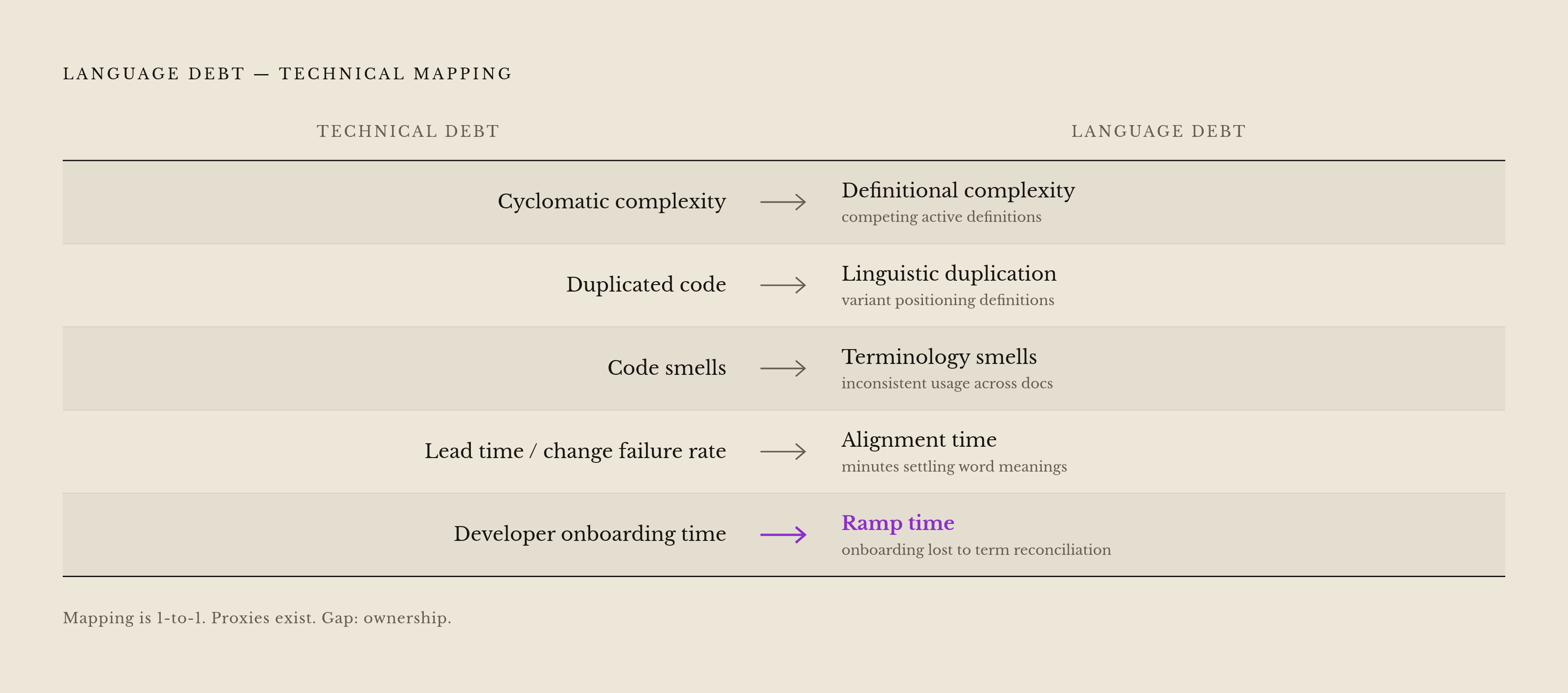
Technical debt is already hard to quantify. There's no standard benchmark for it, nothing like earnings per share that appears cleanly on a quarterly report. Language debt is worse off still, mostly because organizations rarely even try to track it. At least technical debt has a name people recognize in a boardroom.
Look at how technical debt gets measured anyway, because the method transfers almost line for line. IBM's 2026 framework points to code-level signals like cyclomatic complexity, duplication ratios, and "code smells." Measurement approaches track delivery metrics too: lead times, how often changes fail, how much of an engineer's week goes to firefighting instead of shipping. And human cost gets tracked directly, through onboarding time, bug volume, defect rates.
Every one of those has a language equivalent, and the mapping isn't loose. Definitional complexity, how many competing, active definitions exist for a core term, stands in directly for cyclomatic complexity. Linguistic duplication, how many versions of a positioning statement or category definition float around the org at once, plays the same role as duplicated code. Terminology smells appear as inconsistent usage across sales decks, product docs, analyst materials, and internal wikis, findable through a plain corpus audit. Alignment time, how long a cross-functional meeting burns settling what a word means before the real conversation starts, is the language version of lead time and change failure rate. Ramp time, how much of a new hire's onboarding gets eaten by terminology reconciliation, is the direct parallel to developer onboarding time.
Language debt is measurable. It stays unmeasured because nobody assigns it an owner or a method. Tools like SonarQube are commonly used to flag technical debt, a practice the Drexel University multivocal literature review on technical debt in LLM-assisted development (Ehsani et al., 2026) addresses. Language debt doesn't need a piece of software to match it so much as a matching discipline: a corpus audit run against a canonical glossary, on a schedule, with someone accountable for the results. That's a governance gap, not a technology gap, and mixing up the two is how the problem gets shelved indefinitely.
Deloitte's 52% latent-potential jump from data transformation is a useful benchmark here, even loosely applied. Whatever clarity and deal velocity sit trapped behind an organization's unreconciled vocabulary belongs in the same category of value: real, sizable, and currently locked up for no better reason than nobody went looking for the key.
How LLMs transform language debt from a slow-moving liability into an acute operational risk
The timeline just got a lot shorter. LLM adoption is already 67% of organizations worldwide, and Gartner expects more than 80% of enterprises to be running generative AI in production by the end of 2026. Language debt used to compound slowly, over years, mostly out of sight. That window is closing fast, and most organizations haven't noticed it closing.
IBM's 2026 analysis explains the mechanism: AI sits on top of the existing tech stack, and LLMs make it trivially easy to produce huge volumes of content fast, often faster than coding standards or review processes can keep up with. The language version of that is almost too on-the-nose. Train or prompt a model on an organization's existing content, and it doesn't clean that language up. It scales it, contradictions and all.
Fragmented, ambiguous, or flatly contradictory organizational language doesn't stay fragmented at a human pace anymore. It turns into fragmented, contradictory content produced at machine speed and volume, distributed before anyone's had a chance to catch it.
The Drexel review (Ehsani et al., 2026, drawing on 104 sources) names several new debt categories specific to LLMs, and each has an obvious language-side twin. Fast-integration debt, where speed wins over quality and sets off a domino effect into governance debt, mirrors messaging rushed out and never reconciled with the rest of the narrative. Prompt debt, brittle prompts that only work in narrow contexts, mirrors messaging that only lands with one persona or one stage of the sales cycle. Data and provenance debt, low-quality retrieval data feeding a RAG system, mirrors contradictory canonical definitions feeding straight into that same retrieval layer. Model drift, where outputs slowly wander from the intended voice, mirrors narrative drift as generated content moves further from what the organization actually stands for.
A separate finding from the Drexel review carries weight here: looking at 211 million lines of code from major tech companies between 2020 and 2024, GitClear found copy-paste style duplication outpaced refactored reuse for the first time. That's a warning about code, but the language read is direct. LLM-generated organizational content tends to repeat whatever patterns already exist rather than improve on them, so whatever inconsistency is already baked into the source material gets amplified, not smoothed over.
That leaves two very different starting positions, and only one survives contact with an AI stack. An organization with a canonical glossary, a documented narrative framework, and a governed style corpus can prompt-engineer or fine-tune a model to extend that language faithfully. An organization carrying language debt is about to feed that debt straight into its AI stack, at volume, and watch it multiply.
There's a strategic layer too. Research from the Berkeley California Management Review found that most decision-makers engage with AI through narrative rather than technical understanding, so the story a leadership team tells itself about AI shapes its bets as much as any technical evaluation does. Language debt sitting at the top of an organization is a mispricing of strategy itself. It's a mispricing of strategy itself.
AI was supposed to solve organizational communication at scale. For a company sitting on unreconciled terminology, it does the opposite: it takes the mess and locks it in permanently, at a scale nobody asked for.
The discipline required to retire language debt, structured like the discipline that pays down technical debt
Deloitte's 2026 model names two levers for paying down technical debt: infrastructure modernization and data transformation, good for an 18% reduction and a 52% jump in latent potential, respectively, over five years. Targeted structural change beats reactive patching every time, and the same two-lever structure carries over to language debt almost without translation.
The first lever is canonical infrastructure, the language equivalent of modernizing the plumbing. That means a ratified glossary, one with actual decision-making authority behind it, that resolves the competing definitions floating around an organization's core terms. It has to function as a governed reference people are required to check. And it can't sit static: markets shift, categories shift, and a glossary nobody maintains starts racking up its own debt the moment it's published.
The second lever is the language equivalent of data transformation: auditing the active corpus. That means going through the sales decks, the product documentation, the analyst materials, the internal wikis, everything currently in circulation, and checking it against the canonical glossary instead of assuming it already lines up. It's unglamorous work, the same way refactoring old code is unglamorous, and it gets skipped when nobody's tracking whether it happened.
Retiring technical debt only works once an organization admits the debt exists and puts someone in charge of paying it down. Language debt asks for nothing more exotic than that. Name it, measure it against the proxies that already work for code, and pay it down on a deliberate schedule instead of waiting for the next crisis to force the issue. None of this was ever about software alone. It was always about what happens when an organization lets a shortcut sit unpaid long enough to start charging interest.
Sources
- The hidden drag, quantified: Technical debt’s penalty on value and growth
- Faster Code, Deeper Debt? A Multivocal Literature Review on Technical Debt and Its Early Signs in LLM-Assisted Software Development
- Addressing Technical Debt: A Growing Necessity for Federal Agencies
- Reducing technical debt in 2026 | IBM
- 5 Actions To Reduce Technical Debt In Businesses
- arxiv.org