LLM Outputs When Enterprise Knowledge Bases Are Inconsistent
Conflicting source documents undermine RAG systems far more than retrieval algorithms do.
RAG demos always work. Sales team pulls up the chatbot, asks it a clean question, gets a clean answer, everyone nods. Then the system goes into production and starts saying things that make the legal department break out in hives. The pattern is common enough that most enterprise AI teams have a name for it, even if the name is just a resigned sigh.
The mechanism behind that sigh is simple. A large language model doesn't have an opinion about which of two conflicting policy documents is correct, because it has no built-in referee for that fight. Feed it a fragmented, contradictory, or stale set of source documents, and it won't flag the mess. It'll produce a fluent, confident answer that papers right over the contradiction. Researchers looking at enterprise LLM adoption found the real obstacle is the structural gap between scattered technical systems and the reliability that high-stakes decisions demand, not how smart the model is.
Sales describes the product one way. Product describes it another way. Nobody outside a handful of meetings ever notices, because the disagreement stays contained, a private argument nobody has to resolve out loud. Deploy a system on top of that same disagreement, though, and a friction point between two departments becomes a systematic output error, appearing simultaneously to thousands of employees and customers who have no idea two versions even exist. The friction didn't go away. It just found a much bigger microphone.
What the documents actually say, and whether they agree with each other in the first place, matters more than any retrieval-engineering conversation that follows.
Retrieval architecture fails when the problem is upstream of retrieval
Retrieval tuning has a ceiling, and that ceiling is set by whether the source documents agree with one another. No amount of clever chunking, no embedding model swap, no reranking layer will make two contradictory documents suddenly say the same thing. You can optimize the search all day. If the library itself is arguing with itself, the search will just find the argument faster.
Atlan's data quality research describes this exact trap: retrieval looks great in staging, then breaks in production, and the retrieved document ranks highly, the similarity score reads high, and the answer is still wrong. The failure sits one layer above the retrieval pipeline, in the documents themselves. Three culprits show up over and over: source documents that are stale and no longer match current reality, terms that mean different things depending on which department wrote the document, and content nobody owns or vetted in the first place.
Teams routinely spend months tuning search infrastructure while never once asking whether the underlying documents deserve to be trusted. A medical RAG deployment cited in Atlan's research makes the point sharply: clinical recommendations were pulled from guidelines that had already been updated elsewhere, and once the team tightened up freshness governance, recommendation accuracy improved by 18 percent. The retrieval system had been doing its job correctly the entire time. The documents it was faithfully retrieving simply weren't fit to be retrieved.
Metadata enrichment helps at the margins. An IEEE study found real gains from tagging retrieved chunks with structured metadata about source, ownership, and classification. That's polish on a surface with a structural crack, and no amount of metadata changes what the documents actually claim. Configurations that force the model to answer "I don't know" below a certain confidence threshold treat the symptom, a confidently wrong answer, without treating the cause: the conflicting documents that tanked the confidence score to begin with.
None of this is an argument against better retrieval. It's an argument that retrieval is the wrong place to look for the fix.
What makes enterprise knowledge bases inconsistent in the first place
Inconsistency is the predictable output of organizations that never assigned anyone to decide which language, which owner, or which source counts as the real one.
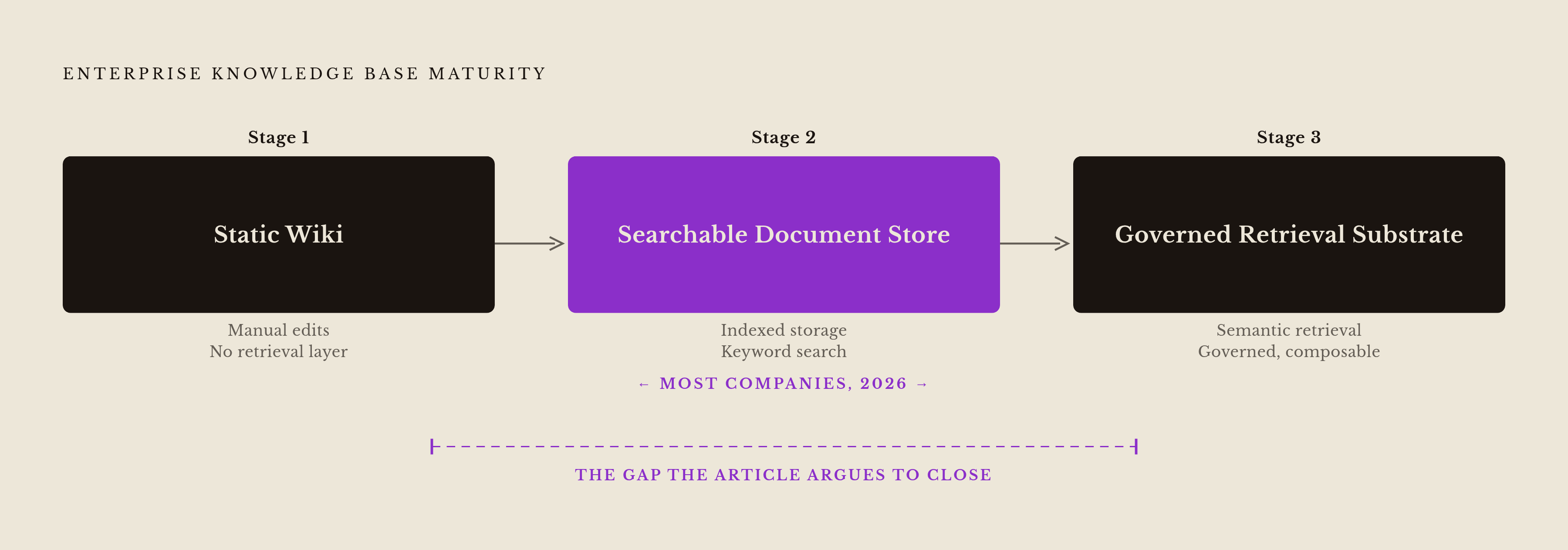
Atlan's architecture research lays out five requirements that separate a real enterprise knowledge system from a consumer-grade one: data certification, access-control-aware retrieval, freshness governance, compliance auditability, and organizational accountability. Most implementations in 2026 are still stuck at stage two of a three-stage evolution, a searchable document store rather than a governed retrieval substrate. Plenty of architecture guides cover retrieval mechanics and security perimeters in exhaustive detail. Almost none of them ask who actually certified the documents before they got indexed in the first place, which turns out to be the question that decides whether any of the rest matters.
Three structural gaps explain most of the mess. No one owns a given knowledge domain with a standing responsibility to keep it current. No freshness signal tells anyone, human or machine, when a document was last reviewed and re-certified. No process checks whether the same term means the same thing across every document that uses it. Put those three gaps together and inconsistency stops being a surprise. It becomes the default state.
Once the language has drifted far enough, leaders themselves lose track of which version is the reference one. Deloitte's 2026 Human Capital Trends research describes this exact pattern in AI deployments, noting that when AI accelerates ahead of any shared framework, organizational debt piles up quietly and only becomes visible once someone is forced to reconcile it.
And this isn't only a quality problem. Ungoverned source data is also an open door. Adversarial actors can inject manipulated documents into an uncertified knowledge base and shape LLM outputs at scale, which makes certification a security control, not merely good housekeeping.
Language debt: the organizational liability that inconsistent knowledge bases make visible
Inconsistent knowledge bases are a symptom. Language debt, the accumulated cost of unclear, fragmented, or competing terminology across an organization, produces inconsistent knowledge bases, and AI deployment makes that debt impossible to keep ignoring.
Language debt builds the same way technical debt does. A product team coins a term. Sales picks up a different one for the same thing. A policy document, written by someone in a third department who never talked to either group, invents a third. None of these get reconciled, because reconciliation was never anyone's job. For years this stays survivable, because the friction appears in slow, human-paced moments, a miscommunication on a sales call, one conflicting slide buried in a deck nobody reads twice. Feed the same fragmented corpus into an LLM, though, and that slow friction becomes a systematic error, delivered instantly across thousands of queries.
Deloitte's research states the stakes directly. When generative AI drafts communications or recommends next steps, it reshapes how people experience authority and expertise inside an organization. When AI builds the presentations, it's also shaping the narrative, the framing, and the agenda that steer decisions. Individually, each of these shifts looks small. Stacked together across a company, they add up to a real change in how the culture actually operates.
The speed compounds the problem rather than solving it. Organizations end up adjusting quietly in the background instead of moving forward with any real clarity, and debt that built up slowly over years starts compounding at machine speed. A Gartner survey of data management leaders found that a substantial majority of organizations either lack the right data management practices for AI or aren't even sure whether they have them, and the firm projects that a majority of AI projects through 2026 will be abandoned for lack of AI-ready data. Model capability was never the bottleneck. Data readiness is, and data readiness is fundamentally a governance question.
A lot of this debt hides in places structured data audits never reach. Policies, strategy memos, meeting notes, most of an organization's real knowledge lives in unstructured text like this, and the inconsistencies inside it are semantic, appearing in ways a clean database schema would never reveal. LLMs are now the machines that drag those semantic inconsistencies into the light and multiply them at scale.
Where language debt in LLM outputs causes the most organizational damage
Language debt doesn't spread evenly across a company. It pools in the places where precise, consistent language directly decides outcomes, deals closing, fundraises landing, alignment holding or breaking.
Enterprise B2B sales feels it first and hardest. When AI sales tools draw from a fragmented knowledge base, field reps lose clarity and confidence, distribution partners fall out of sync, and the feedback loop between departments stops functioning. A large share of B2B SaaS companies already rate their own pipeline creation as merely "somewhat effective," and that gap widens further once AI starts amplifying the inconsistency instead of fixing it.
Founders scaling fast run into a version of the same problem, just with higher stakes attached. The internal story fractures across departments as the company grows, and AI tools that ingest all those disparate documents faithfully reproduce every fracture. The traction story that earns investor confidence (steady growth, retention that actually holds, a narrative that explains the curve on the chart) depends on internal language holding together, and fast-scaling companies are exactly the ones least likely to have kept it that way.
Investor diligence has gotten sharper because of this. AI-assisted diligence is now common practice among larger corporate venture funds, and a company whose internal documents contradict its external pitch runs a real risk of getting caught. Independent conversations with customers and former employees test whether the pitch survives outside the founder's own telling of it, and AI-assisted review speeds up exactly that kind of triangulation.
Internal decision-making takes a quieter hit. Culture debt becomes visible right here: when no single version of a term, a category, or a customer story carries any real authority, decisions default to whoever spoke last, or now, to whatever the LLM happened to retrieve most recently. AI-supported recommendations often speed decisions up, but accountability and decision rights rarely get redesigned to keep pace.
Regulation closes the loop with actual deadlines attached. General enforcement under the EU AI Act began August 2, 2026, with the full high-risk system requirements pushed to December 2, 2027 under the Digital Omnibus, and penalties for non-compliant high-risk systems can reach 7 percent of global revenue. A knowledge base that can't produce a clean audit trail, which document got retrieved, who owned it, when it was last certified, is a legal exposure with a fine attached. It's a legal exposure with a fine attached.
Why better data governance alone does not resolve the problem
A perfectly cataloged library of documents that all contradict each other is still, at the end of the day, a contradicting library. Data governance fixes provenance.
The standard practitioner instinct treats knowledge base inconsistency as a cataloging problem, solvable with better metadata tagging, certification, and access control, and the architecture literature backs that up as far as it goes. It just doesn't go far enough. If the sales team and the product team genuinely believe two different things about who the product is for, tagging both of their documents with correct ownership metadata and a fresh timestamp doesn't settle the disagreement. It just hands that disagreement to the LLM more efficiently, and the model synthesizes the contradiction into an answer anyway.
Governance answers one question: is this document certified, current, and properly owned? Narrative coherence answers a different one entirely: do these documents actually agree with each other on what's true? A data catalog has no mechanism for answering the second question, no matter how well it's built.
There's a subtler cost stacking on top of this, too. Research on AI-assisted drafting found that people who lean on AI for primary authorship lose some of their ability to recall or genuinely engage with what they just produced. Scale that up to the organizational level. When AI handles most internal communication and documentation, the human habit of noticing and correcting language drift starts to atrophy, and the debt becomes self-reinforcing rather than self-correcting.
The practical fallout: companies that pour their entire AI budget into retrieval architecture and data governance, while leaving organizational language ungoverned, will get sharper answers to clean, well-formed questions. A question that touches a contested term, a fuzzy category boundary, or a strategic claim nobody ever nailed down will still get confused, contradictory output.
Narrative coherence as a prerequisite for AI-ready knowledge infrastructure
Before any LLM can be trusted with reliable enterprise output, someone has to do the unglamorous work of deciding what the canonical language actually is: which terms mean what, in whose voice, across which documents. Skip that step, and the model will treat whatever it happens to retrieve as gospel.
Researchers propose a risk-controlled data flywheel architecture that integrates perception, reasoning, verification, and governance layers, where the governance layer is a continuous feedback loop that feeds back into retrieval and structural components. The same logic applies almost exactly to narrative. Canonical language has to feed back into every document that enters the knowledge base, not sit off to the side as a style guide nobody opens.
Building that canonical layer means naming an actual owner for each knowledge domain, with real renewal responsibility attached, a standing role rather than a name on a wiki page nobody updates. It means settling on one authoritative version of contested terms (what "customer," "revenue," or "active user" actually means inside this specific organization). It means version control when strategic language shifts, and a real process for pushing those changes across every affected document before anything gets re-indexed.
Atlan's architecture research traces the knowledge base concept through three stages: the static wiki, the searchable document store, and the governed retrieval substrate that 2026-era enterprise architecture actually needs. Most companies are still parked at the searchable document store stage. Narrative coherence is what separates stage two from stage three, a genuine requirement rather than a nice-to-have layered on top of it.
An offensive angle matters here too, one worth taking seriously rather than filing under marketing. Whoever defines the vocabulary of a category controls the language an LLM retrieves the moment anyone queries that category. Category creation was never just a branding exercise. It's a retrieval architecture decision, whether anyone frames it that way or not. A company that never bothered to write the canonical documents defining its own category leaves that vocabulary sitting on the table, free for competitors, analysts, or the model's own training data to define instead.
Narrative infrastructure, the discipline of architecting, governing, and maintaining canonical organizational language as an actual durable asset, is a layer data governance quietly assumes already exists. For most enterprises, it doesn't. AI deployment is what turns that missing layer from background friction into a structural liability, sitting in plain view, with a bill attached whenever the model gets asked a question the organization never agreed on how to answer.