
Onboarding Failure Costs From Undocumented Organizational Language
New hires flounder for months because companies never write down how they actually talk.
Onboarding failure has a price tag everyone quotes and a cause almost nobody names. The number that gets thrown around in board meetings, that $1,830 to $28,000 range depending on how you count it, is the fever, not the disease. It's the fever. The disease is that most companies never write down how they actually talk, think, or decide, and new hires spend months trying to learn a language with no dictionary.
Why the root cause stays off the balance sheet
Every company with a finance team tracks debt down to the penny. Every engineering org worth its salt tracks technical debt, usually with a ticket backlog to prove it. But almost nobody tracks the third kind: communication debt. Call it the quiet cousin nobody invites to the budget meeting.
Financial debt appears on a balance sheet. Technical debt appears on a roadmap, even if it's the item everyone keeps punting to next quarter. Communication debt is not tracked anywhere, so it compounds in peace. It becomes visible later as operational friction, as a new hire who's been "ramping" for four months and somehow still asks what "the Atlas number" means in the Tuesday pipeline review.
Grammarly's 2025 State of Business Communication report puts the cost of ineffective communication at up to $1.2 trillion a year for businesses in one country. businesses. Separately, institutional knowledge loss is estimated to cost U.S. companies $1.3 trillion annually, and the average knowledge worker sticks around for just 4.1 years. Do the math on that tenure number: the clock on undocumented knowledge isn't just running, it's basically a countdown timer strapped to every senior hire the day they sign an offer letter.
What undocumented organizational language is and where it lives
Organizational language is the operational layer underneath brand voice and the jargon on your careers page. The operational layer produces all of that, the stuff nobody bothers explaining because everyone who's been there long enough already "just knows.""
Four places it tends to hide:
- Terms that mean one thing in Sales and a different thing in Product, so a new hire gets contradictory answers depending on who they happen to ask on a given Tuesday
- Decision frameworks that live entirely inside a few senior people's heads. Onboarding decks teach the what. Nobody ever writes down the how, the actual judgment calls that separate a good decision from a defensible one
- The narrative logic behind big strategic bets, never documented, so a new hire literally cannot pass along reasoning they were never given in the first place
- Market and competitive framing that Sales pitches one way and Product describes another, creating a fault line right at the point where customers actually notice
LinkedIn's 2025 Workplace Learning Report found that business strategy topped the list of skills at risk when someone leaves, ahead of strategic planning, sales management, and project planning. Those aren't skills you can bullet-point into a wiki. They're absorbed, slowly, through exposure to language nobody wrote down.
The point is hard to argue with: narrative is infrastructure that somebody has to build on purpose, or it doesn't exist. It's infrastructure. Somebody has to build it on purpose, or it doesn't exist.
How undocumented language translates directly into ramp time and attrition
New hires generally take somewhere between 6 and 12 months to hit full productivity. Adding in the weeks or months a role sat empty before they started, one departure can cost an organization close to a year of a seat running below capacity. That's not a rounding error. That's most of a fiscal year.
Ramp failure often looks like nothing at all. It just looks slow. And it stays invisible because most companies never check whether onboarding actually worked. A majority of HR leaders cite the absence of tools to assess whether onboarding worked as a core gap, meaning most organizations are flying blind on whether any of it stuck. No measurement, no problem, at least on paper.
Meanwhile, 41% of daily work time gets burned on activities that don't move the needle, often thanks to outdated processes or meetings that could've been a message on a workplace chat tool. That's not laziness. That's the tax of navigating a system nobody mapped out.
New hires, asked directly, paint a bleaker picture. Gallup found that only 29% feel fully prepared to do their job once onboarding wraps. The rest are wandering around with no map, which is a rough spot to be in, given that the map in question was never actually drawn.
The multiplier effect when a senior person carries undocumented language out the door
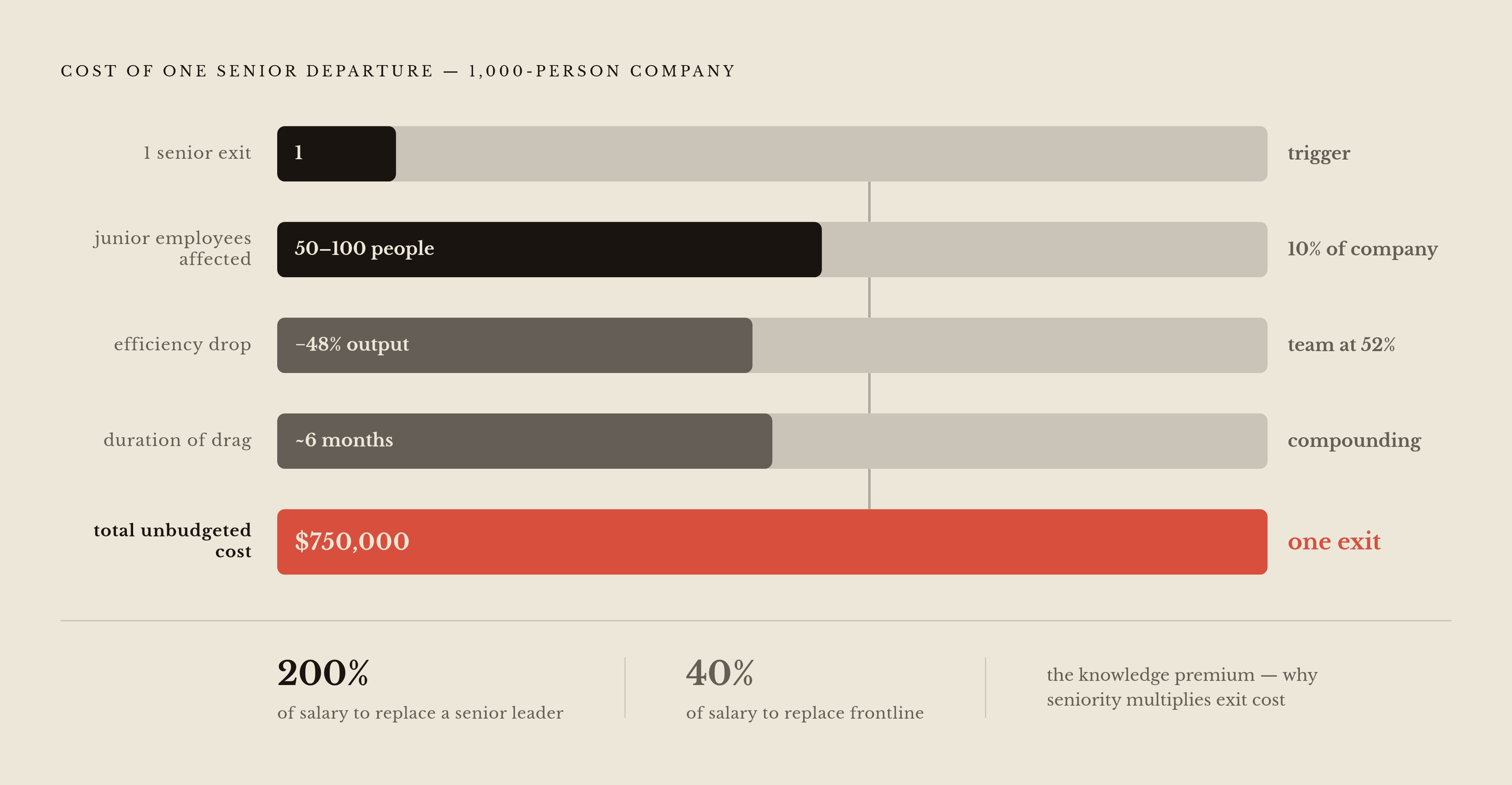
Losing a junior employee stings. Losing a senior one is closer to an earthquake, and the aftershocks hit everyone standing nearby. When a senior team member or advisor leaves, the 50 to 100 junior employees connected to them see efficiency drop by 48%. Replacing that person takes roughly six months, during which the surrounding team operates at 52% efficiency. For a 1,000-person company, that comes out to $750,000. Not a typo. Three-quarters of a million dollars, from one exit.
Gallup estimates replacing a leader or manager costs around 200% of their salary, compared to roughly 40% for a frontline role. That gap functions as a knowledge premium, priced in. It's a knowledge premium, priced in.
The failure rate backs this up in an uncomfortable way: Leadership IQ found that 50% of senior outside hires fail within 18 months. That's a coin flip. When half of expensive, carefully vetted hires wash out that fast, the new leader walked into an organization whose real decision logic was never written anywhere they could read it. It's that the new leader walked into an organization whose real decision logic was never written anywhere they could read it.
The senior person who just left carried a whole narrative around in their head, how the company frames its market, what makes it different, why certain calls got made three years ago. None of that lived in a slide deck. It lived in the way they explained things in a hallway, or the way they ran a meeting when things got tense. Once they're gone, that narrative doesn't get replaced. It just gets improvised, badly, by whoever's left.
What AI-powered onboarding does when the language underneath it is undocumented
AI onboarding tools are already past the early-adopter phase. An IDC TechBrief cited by Enboarder found that sixty percent of organizations are using or piloting AI-powered onboarding right now, and another 25% plan to invest within the next 12 to 18 months. This is not a future trend. It's already sitting in most companies' HR stack.
AI systems don't fix fragmented language, they photocopy it. An onboarding AI fed a pile of inconsistent, half-documented internal materials will faithfully reproduce every contradiction, at scale, to every new hire, simultaneously. It's less a teacher and more a very confident parrot with a distribution list.
Industry analysts project a significant share of agentic AI projects will get canceled by 2027 over cost, unclear value, or weak risk controls. Separately, research cited by Atlan (sourced from MIT's NANDA initiative) found 95% of enterprise AI pilots fail in production, and the leading cause is missing context. It's missing context because nobody wrote down what the company actually meant. Which, translated out of technical jargon from the company behind the system, means: the system didn't know what the company actually meant, because nobody had written it down for the system to learn from in the first place.
What treating organizational language as documented infrastructure requires
Code without discipline turns into technical debt. Skipping tests and documentation eventually makes the whole thing groan under its own weight. Organizational language works the same way. Skipping definitions and decision rationale means every bit of added complexity multiplies the confusion instead of just adding to it.
This approach treats narrative infrastructure the way an engineer treats a production system: something designed, maintained, and governed, not something that just shows up because the culture is good.
In practice, that means a few concrete things:
- A canonical vocabulary. Terms defined once, consistently, available to a new hire on day one instead of months down the line What was decided matters less than why
- A single governed market and competitive narrative, so Sales, Product, and every new hire are working from the same page instead of three different drafts of it
- Some mechanism for catching drift. Think of it like a call-recording review, but for language: checking whether the vocabulary is actually being passed down or quietly reinvented department by department
Research consistently shows that structured onboarding remains far from universal. Structured onboarding and documented language aren't the same project, but the uncomfortable truth is most companies are missing both.
Calculating language debt as a line-item cost, not a cultural soft spot
None of this is an HR problem dressed up as a bigger one. It's a language infrastructure problem, and it comes with a number attached, even if that number currently lives nowhere on anyone's spreadsheet.
Stack the pieces up: $7,500 to $28,000 in true onboarding exposure per hire, 6 to 12 months of ramp time at partial output, 90% to 200% of salary if that hire walks within the year. Now add the $750,000 annual drag a single senior departure creates in a mid-size organization. The figure that emerges dwarfs whatever line item currently says "onboarding budget."
Language debt compounds exactly the way technical debt does. Defer the documentation once, and every hire after that pays the cost of reconstructing what should've been written down the first time. Every AI tool trained on the mess inherits the mess. Every senior departure takes one more undocumented layer out the door with them, and nobody notices until the replacement fails within 18 months, right on schedule with research showing half of senior outside hires don't make it that far.
So the real question for anyone holding a budget isn't whether documenting organizational language costs something. It does cost something. The question is what's currently being paid, quietly and repeatedly, to avoid doing it once.