AI-Assisted Category Misclaim in Platform Technology Companies
AI amplifies vague product claims into regulatory liability at machine speed.
This article is about how AI turns a company's imprecise category language into legal exposure at machine speed. The companies in the enforcement cases below didn't set out to defraud anyone. They set out to win a crowded market, and the words they chose to do it got amplified faster than anyone could check them.
Platform companies arriving at category misclaim without intending to
Picture a SaaS founder in a pitch meeting, choosing between two product descriptions. One says "AI-powered workflow platform." The other says "workflow platform." Every incentive in the room points to the first option, because buyers respond to the AI label with higher perceived value and stronger purchase intent, even when the product underneath is functionally identical. That pressure doesn't stay in the pitch deck. Troutman Pepper Locke's analysis documents how it gets encouraged up the management chain, from marketing to sales to the executive team, until "AI-powered" becomes the default description for anything with a database and a dashboard.
Nobody signs off on a lie in a meeting like that. What happens instead is a company reaches for the label that wins attention, rather than the language that actually describes what the product does and for whom. It is a language architecture problem, because it starts well before anyone touches a press release. The category vocabulary gets picked competitively, not built from a clear diagnosis of what the product replaces and what the buyer would otherwise be stuck doing.
That diagnosis matters because a category has to name an enemy, and the enemy is almost never a competitor. It's a manual workaround, a spreadsheet somebody built long ago that nobody has the courage to kill. A status quo habit that costs the buyer time and money every week. Calling a product "AI-powered" without naming that enemy is a claim without the substance to back it up, a label stapled onto a product rather than grown out of it.
Somebody might object that companies know what their products do, so this looks more like marketing exaggeration than a language failure. The enforcement record says otherwise. Finance documents, product descriptions, investor communications, and internal sales scripts routinely describe the same capability in three or four ways, all inside one company. A fragmented, ungoverned language system produces different versions of the truth depending on which document you happen to open, and that fragmentation is the raw material AI will later amplify, far beyond one bad headline slipping past legal review.
AI and Imprecise Category Language
AI doesn't fix imprecise language. It reproduces imprecise language, fast, and in every direction at once. A large language model trained on or operating inside a company's existing content inherits whatever inconsistencies and overstatements already live in that content, then writes them back out across outbound emails, sales enablement decks, product copy, investor updates, and customer-facing chat interfaces, all at the same time.
Think about what that means mechanically. A single overstated category claim once sat quietly in one marketing document, but now it seeds dozens of AI-generated outputs before a single human reviews any of them. The claim doesn't stay put. It spreads into a sales rep's follow-up email, a chatbot's answer to a prospect's question, a one-pager a partner downloads and forwards. Each of those outputs looks independently generated. Each one actually traces back to the same unexamined sentence.
Ungoverned language compounds the way technical debt compounds. Every new AI output built on top of imprecise source material adds another layer of inherited confusion, and somebody eventually has to unwind every layer by hand. AI scales a category claim faster than any team can audit and correct it, so the gap between what the company claims and what the company actually does keeps widening no matter how diligent the review process is. A quarterly content audit cannot outrun a system that generates hundreds of customer touches a day.
That asymmetry is the whole argument for treating narrative precision as something that happens before deployment, not after it. Auditing AI output after the fact is bailing out a boat with a leak nobody patched. The language the AI runs on has to be governed at the source, because once imprecise claims enter the generation pipeline, correcting them means finding every surface they reached and fixing each one individually, and that list of surfaces grows every day the problem goes unaddressed.
How regulators and private litigants read the output of that amplification
Regulators built an enforcement apparatus that catches what an ungoverned AI language system produces: capability claims, stated outright or implied, that the technology underneath cannot support. The FTC has brought thirteen AI washing enforcement actions, and it treats deceptive AI capability claims as violations of Section 5 of the FTC Act; it draws no line between a claim you state directly and one merely implied by the product's name or design.
Express claims are the easy category to picture: an ad, a product description, a press release, or an investor letter that states flatly that a product uses AI when it doesn't. Implied claims are subtler and just as dangerous. A product name, a logo, an interface choice, or marketing copy can make you think a product uses AI without ever using the word. A platform called "NeuralAdvisor" or a diagnostic tool branded with "Intelligence" can carry the same legal exposure as a company that put "AI-powered" in bold on its homepage.
Private litigants have their own route in. The Lanham Act lets a competitor sue over a literally false AI claim, and describing a product as "AI-powered" when it contains no AI component qualifies. That kind of falsity lets the plaintiff presume consumer deception without producing a consumer survey, which clears the path to preliminary injunctive relief that can shut down a marketing campaign before the case ever reaches final judgment. Trademark filings carry a parallel risk: marks built around AI-suggestive terms, filed with the U.S. Patent and Trademark Office, are vulnerable to deceptive misdescriptiveness challenges under Section 2(a) of the Lanham Act whenever the product behind the mark fails to actually use AI.
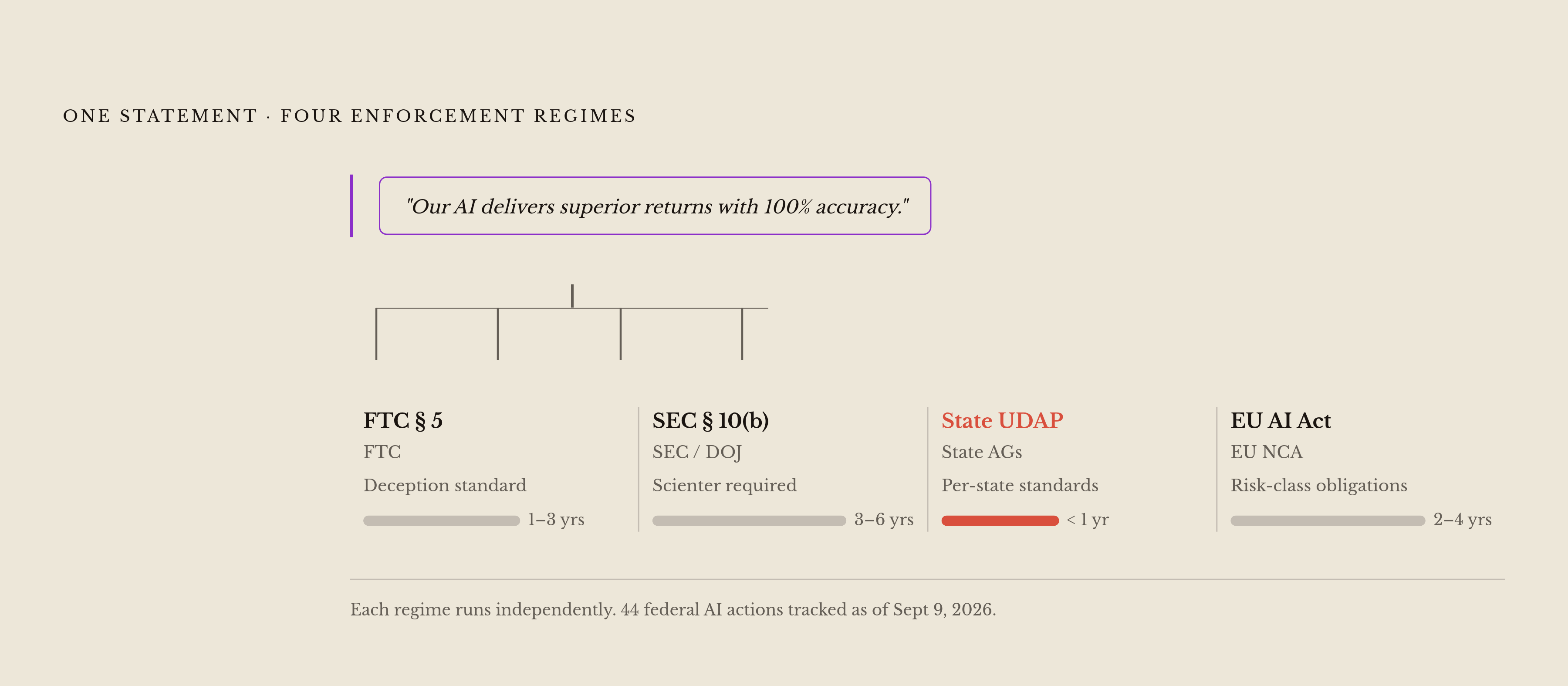
A single AI marketing statement can trigger four separate enforcement regimes at once. FTC Section 5. SEC Section 10(b). State unfair and deceptive practices statutes. And, for any company with EU exposure, the EU AI Act. So one imprecise sentence, reproduced across dozens of surfaces by AI, does not create just one legal problem. It creates four simultaneous ones, each with its own regulator, its own standard of proof, and its own timeline. The federal AI enforcement tracker, checked September 9, 2026, counted forty-four federal AI enforcement actions across the FTC, SEC, DOJ, EEOC, and FCC where the agency's own materials expressly reference AI, with several cases changing status in the preceding weeks alone.
How misclaim unfolds in practice
The SEC's case against Albert Saniger, filed April 9, 2025 under docket 1:25-cv-02937, accuses him of raising over $42 million on the strength of false AI claims. His shopping app was marketed as using AI to process transactions. Manual workers did the processing instead, so the automation rates the company put above ninety percent were, the complaint states, essentially zero. That's not a company that shaded the truth a little. The gap between the category claim and what the product actually did was a difference in kind.
Presto Automation faced SEC action dated January 14, 2025. The company described third-party speech-recognition technology as its own proprietary system and claimed its Presto Voice product eliminated human order-taking at drive-through windows, when most orders still needed a person to step in. That's an implied category claim, the kind built into a product's core pitch rather than a single ad, which is exactly the kind an AI system would have distributed across every customer touchpoint the company owned.
DoNotPay's case closed with a final order on September 25, 2024, barring the company from deceptive AI-lawyer claims and requiring monetary relief and notice to past subscribers. The company's category name, "the world's first robot lawyer," was the misclaim. There was no separate overstated ad campaign to point to. The name itself was the claim, and the name is the thing that gets repeated most often, by salespeople, by customers, by any AI system summarizing what the company does.
Delphia and Global Predictions round out the pattern. Delphia was penalized for claiming it incorporated client data into its AI algorithms when it had never done so. Global Predictions called itself "the first regulated AI financial advisor," a claim it couldn't back up with documentation because the underlying AI capability didn't exist. On the criminal side, United States v. Albert Saniger (indicted April 9, 2025) and United States v. iLearningEngines (indicted April 17, 2026) show that the most severe cases of ungoverned category language don't stop at a civil penalty. They reach criminal exposure.
Lay these cases side by side and one thread runs through all of them. In every case, the language describing the category arrived before the capability that would have made the language true. And in every case, there was no governance structure in place to catch that gap before it became a liability someone else had to litigate.
Category misclaim as an internal organizational failure before it becomes an external legal one
The same fragmented language that misleads customers hurts the company inside the building first. Investors notice fast when a finance document says one thing, a legal filing says another, and the product marketing says a third thing. That kind of mismatch reads as execution risk to anyone doing diligence, and clean, consistent language across every document builds investor trust faster than any polished pitch deck can.
Sales teams carry a separate version of the same cost. Category positioning collapses when a sales rep pitches last quarter's language on a discovery call, but marketing has already published this quarter's rebrand. A prospective buyer's first real signal that a company is disorganized is language that doesn't hold together across the surfaces they encounter on the way to a purchase decision, not a bad demo.
That matters more than it might seem at first, because of how B2B buying actually works. Buyers form a preferred vendor ranking before they ever talk to a salesperson, and they buy from that early favorite the large majority of the time. The category claim, the problem framing, the language a company runs before a human enters the conversation, is doing nearly all the persuasive work before the sales call even starts.
Most positioning documents can't carry that weight, because most of them are too vague to be useful. They lean on category language that could describe three or four competing vendors, they list product attributes instead of the decisions those attributes let a buyer make, and they avoid ever saying who the product isn't for. That vagueness is language debt in its most common form, sitting quietly in a slide deck until someone has to pay it off.
AI doesn't sharpen that vagueness when it operates on it. It distributes the vagueness across every touchpoint the company has, which makes the misalignment harder to find and harder to fix, because now it lives everywhere at once instead of in one slide a reviewer might eventually catch. Correcting ungoverned category language at that stage works like retiring technical debt at scale: the longer the imprecision sits there, the more surfaces have to be found, audited, and rewritten simultaneously, and the bill only grows with time.
Principled category creation built to hold
Fixing this problem does not start with a tighter legal review of marketing copy. It starts with building category language from the problem the product replaces, not from the label the market currently rewards. One diagnostic question separates genuine category creation from misclaim: what specific old way of doing things does this product replace? The answer has to be a behavior, a workaround, or a status quo habit, not the name of a competitor's product.
Category creation only makes sense when the existing categories genuinely fail to describe the value a product delivers, and when naming something new costs less than trying to outspend the established players already sitting in an existing category. A company that reaches for the AI label without clearing that bar is borrowing a category, and borrowed categories tend to come with someone else's baggage attached.
There's a clear signal that category language has stopped being internal and started living in the market: prospects begin repeating the category name back, unprompted, on discovery calls. Everything that happens before that point is testing. Everything after it is compounding, in the good direction this time, because now the market is doing some of the explanatory work the sales team used to have to do alone.
For language to survive AI amplification rather than get distorted by it, the language has to be specific enough that a model can't drift it. Vague capability claims like "AI-enhanced" or "intelligent platform" are the most exposed to this kind of drift, because they're the easiest phrases for a model to embellish without anyone noticing the embellishment happened. Precision is what makes category language durable under that pressure. A claim that names a specific enemy, a specific buyer, and a specific outcome that buyer can't reach any other way is much harder for AI to misclaim, because every surface reproducing that claim is constrained by the same specific facts. One well-known example: Gong built its category around revenue intelligence rather than generic "AI-powered sales software," naming a specific workflow it replaced and a specific buyer it served. Precision like that is the structural property worth building toward, regardless of the product or the market it's competing in.