
Prompt Engineering Assumptions and Organizational Language Risk
AI systems inherit organizational language problems and amplify them at scale.
Prompt engineering used to mean finding the right words to type into a box. That part is mostly over. By 2026, running prompts in production means version control, rollback plans, A/B testing, audit trails, and compliance paperwork, the full kit of a managed engineering practice rather than a knack for phrasing. Gartner said as much in a research note: "context engineering is in, and prompt engineering is out. Gartner also predicted that by 2028, context engineering features will be built into 80% of the software tools used to build AI applications. That's a forecast that the job is shifting from writing clever inputs to managing the context those inputs pull from. And that raises a question the field hasn't fully sat with: if context is the new unit of work, what is that context actually made of?
What every prompt is running on
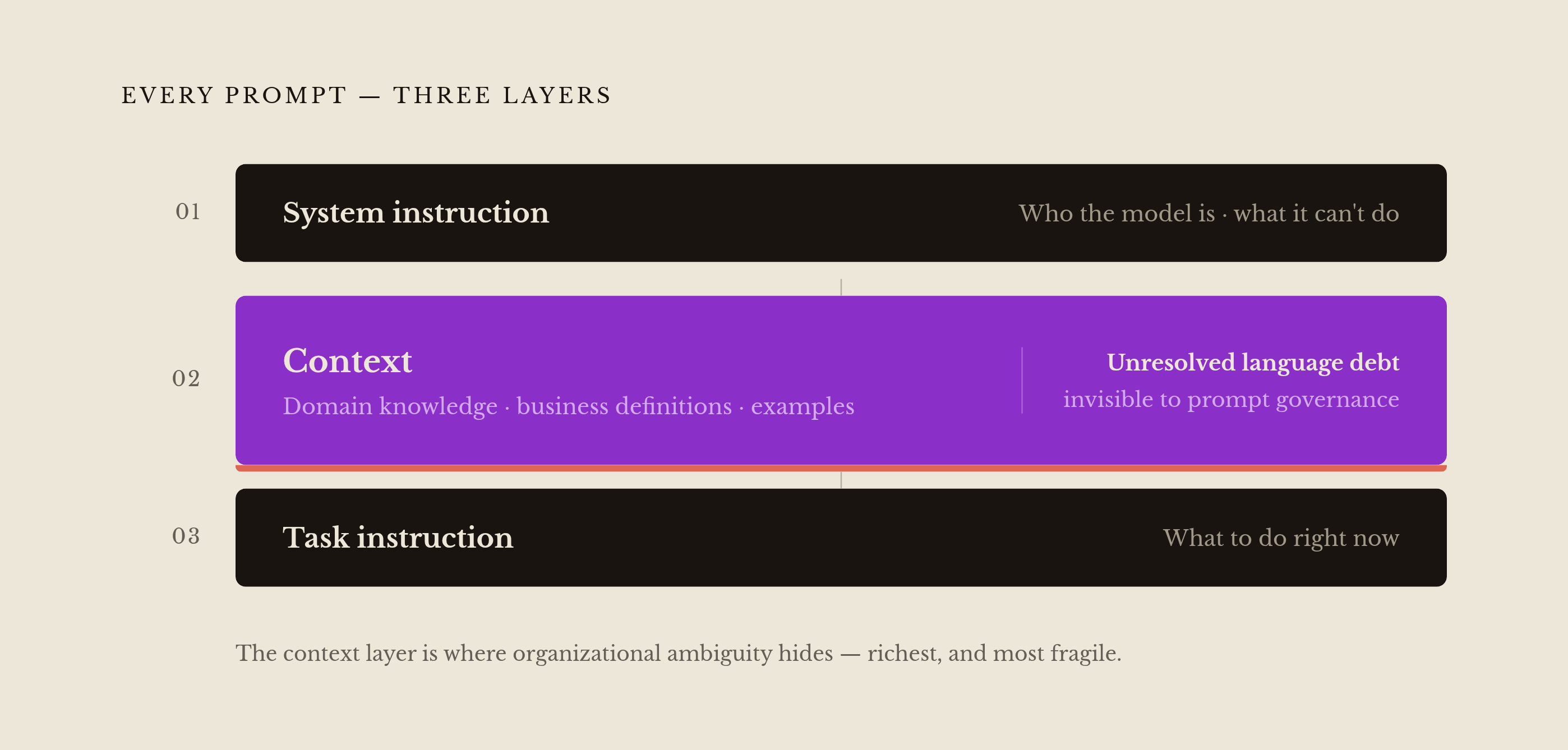
A prompt is a stack with three layers: the system instruction (who the model is supposed to be, what it can't do), the context layer (domain knowledge, business definitions, examples), and the task instruction (what to actually do right now). The middle layer is where things get interesting, because that's where an organization's own language lives, its terms, its categories, its working definitions of what things mean.
Here's the catch. That's a data governance problem wearing a prompting disguise, and it costs real time every time it repeats.
The model doesn't fail loudly when this happens. It fills the gap with its best guess, something fluent, confident, and reasonable-sounding, which is exactly the problem: the guess often reflects the organization's own unresolved ambiguity handed right back to it with a straight face. This isn't limited to big, dramatic use cases either. An analyst asking a tool to summarize a report and a multi-agent pipeline running sales qualification both inherit the same pile of undefined terms and inconsistent categories. Neither one gets to opt out.
How fragmented organizational language becomes a prompt engineering problem
Picture the pattern: definitions aren't governed anywhere, so the knowledge lives in a few people's heads, and prompt engineers end up typing it all in by hand. Every new deployment, every new team, every new use case produces its own version of the same unresolved question. Nobody's wrong exactly. Everybody's guessing differently.
Manual prompting holds up fine at a small scale. One team, one use case, one engineer who knows the business cold. Past that point, without some shared, governed source of context, the system starts generating inconsistency on its own, and that inconsistency compounds into real maintenance debt. The mess isn't random, either; it's a mirror. Different teams using different words for the same idea will get AI outputs that quietly disagree with each other, and that disagreement is harder to catch than old-fashioned confusion because it appears polished, confident, and ready to quote in a meeting.
A fair objection here: can't a good system prompt just define the terms up front? Sure, for one use case, with one engineer maintaining it. But that prompt isn't shared across teams, it drifts over time as the business changes, and it vanishes the day that engineer leaves the company. A well-written prompt is a patch. It's not a fix for the fact that nobody agreed on what the words mean in the first place.
Why AI amplifies organizational language rather than correcting it
Before AI tools showed up, fragmented language had built-in brakes. A reader would notice when two documents disagreed. A meeting would surface the disagreement out loud. A confusing memo would just sit there, unread, doing no damage. Friction slowed the spread of the confusion.
AI strips away that friction almost completely. Feed a fragmented organizational story into a language model and what comes back is fluent, coherent, and delivered with total confidence, which makes it harder to challenge than a messy document ever was, because everything about the surface says "trust this." That's the real shift: AI-generated answers built on shaky language give people a ready-made reason to stop checking. Decisions get accepted because the output sounds right, not because anyone confirmed it was. Once people stop checking and accept output because it sounds right, the confusion carries real weight in actual decisions.
Better prompt-writing technique, on its own, can't fix the underlying issue for this reason. A beautifully structured prompt run on top of ambiguous organizational language produces output that's ambiguous too, just reliably so, delivered fast, and repeated identically across every team plugged into the system.
Language debt: the structural liability that prompt governance cannot see
Language debt is accumulating underneath all of this. It's the unpaid cost of every deferred decision about terminology, every undefined category, every competing version of the company's own story floating around different departments. It's the raw material every prompt system has no choice but to run on.
Language debt behaves a lot like technical debt. Deferring a decision about what a term means doesn't make the bill disappear; it grows, appearing later in clarification meetings, mismatched outputs, and rework nobody budgeted for. The symptoms are easy enough to measure: how many hours get burned in meetings just clarifying what a term means, how often a project stalls because two teams define success differently, how long it takes a new hire to repeat the company's own story back correctly. None of those are the disease. They're the fever.
The actual cause sits further back. The website describes the company one way, the sales deck implies something else, and leadership says a third thing in public. That mismatch is language debt in its purest form, and no prompt system checks for it before swallowing it whole. Unlike a server outage, language debt doesn't set off any alarms. It appears quietly in AI output that's just slightly off in a way that's hard to pin down, reflecting the organization's own uncertainty back at production volume. Vague language does damage even without AI in the picture: when leaders lean on jargon instead of specifics, teams lose the concrete detail they need to actually decide anything, and each function ends up optimizing for its own local version of the truth, which is a slow, expensive way to drift apart.
What prompt governance frameworks address and miss
It's worth being fair about what existing prompt governance covers, since plenty of organizations already have it in place. Researchers Neumann, Sargeant, and Singh point out that governing AI through natural language is a genuinely new kind of problem: language is open-ended, dependent on context, and unstable in its meaning in ways that formal code simply isn't, so the governance tools built for code don't transfer over cleanly.
Current prompt governance frameworks do real, necessary work: defending against prompt injection, stopping system prompt leakage, sanitizing outputs, keeping version history and audit trails, and handling GDPR or HIPAA compliance where a prompt touches sensitive data. None of that is wasted effort.
What those frameworks don't touch is whether the terminology baked into a system prompt reflects an actual governed definition or just one engineer's best guess. They don't check whether the categories used in a set of examples line up with how a different team classifies the same thing. They don't ask whether the story the AI is reproducing is the organization's real strategic narrative or a local stand-in for it, invented under deadline. None of this is a flaw in the frameworks themselves. It's a mismatch in what's being measured: these tools treat the prompt as the unit worth governing, when the real unit at risk is the organizational language sitting inside it. The same researchers note that because natural language is so open to interpretation, even well-meaning prompt policies get applied inconsistently from team to team, which is the exact same language debt problem occurring one layer up, inside governance itself.
Narrative infrastructure as the layer prompt engineering depends on
Reliable prompts need something to stand on: defined terms, stable categories, a canonical version of the company story, and someone whose job it is to keep all of that current. Call it narrative infrastructure, the set of definitions and language conventions an organization uses to make everyday decisions without re-litigating what words mean every single time. It works like scaffolding: it lets teams spread out and move fast without constantly checking in with each other to make sure they're still talking about the same thing.
When that scaffolding exists and is actually governed, it can get fed into prompt context automatically instead of being rebuilt by hand every time someone opens a new chat window. That's the real difference between manual prompting and systematic context engineering: governed infrastructure replaces one-off context assembly, scales to hundreds of prompts without piling up debt, and produces outputs that agree with each other across teams instead of quietly contradicting one another.
Governing language this way needs the same disciplines code already gets: version control, clear ownership, a process for managing change, a trail showing what was decided and when. The twist is that language governance runs on institutional judgment calls about meaning, not just tooling. The obvious pushback is that most companies have neither the taste nor the process for this kind of work. Fair, except they're already doing it, just by accident, through whoever happens to write the system prompts that week, whoever briefs the AI tools, whoever the CEO happens to be on the day they describe the company's strategy to a model. The only real choice is whether that governance is deliberate or left to chance. This is the discipline Storied's work around narrative infrastructure and the Storied OS is built to formalize, architecting one canonical language layer that AI systems, sales teams, and leadership all draw from, so what the organization actually means is what comes out the other end.
What governing organizational language requires in practice
Governing language this way isn't an abstract exercise, it has a concrete shape. Start with canonical documents: a governed glossary that spells out what the organization actually means by its core terms, not just what it happens to call them, written so it can be dropped straight into prompt context instead of reconstructed from memory each time.
Then there's ownership. Language decisions need owners the same way database schemas do: someone accountable when a term's meaning shifts, a defined way to spread that change through the organization, and a record showing what the company meant at any given point in time.
Add drift detection on top of that, the language equivalent of a security scan, run on a schedule, checking whether the website, the sales deck, the AI system prompts, and whatever leadership is saying publicly still agree with each other. Catching the gap before AI deployment prevents the amplified version from reaching every downstream system, which is harder to undo after the fact.
The best operational narratives give people precise guidance instead of vague aspiration. They're clear about which situations demand exact language and which ones leave room to improvise, and they hold their core definitions steady even while allowing flexibility elsewhere. None of that sticks unless the organization's spending and credit-giving reflect it; consistent signals back it up or it fades.
One group carries outsized weight here: founders and CEOs. Whatever version of the company story a CEO happens to tell the model while briefing an AI tool becomes the version that gets amplified across every system downstream. That makes discipline about language at the top a basic requirement for using AI at scale, a responsibility owned at the top rather than deferred to communications later.
The prompt engineering question organizations should ask before the technical one
Before asking how to write a better prompt, organizations should ask whether the language running underneath our prompts is something we actually want copied at speed and at volume.
Prompt engineering technique is a multiplier, nothing more and nothing less. It multiplies whatever is already sitting in the organization's language, good or bad, clear or muddled, and that multiplication is now happening at full production scale, across every team with access to an AI tool. Fix the words first. The prompts will follow.