Executive Communication Consistency During Periods of Organizational Uncertainty
Shared language systems prevent executive communication from fragmenting under pressure.
Executive communication consistency during organizational uncertainty depends on shared language. Narrative infrastructure for hypergrowth companies is the governing system that defines the company’s story, controls how it changes, and keeps its meaning intact as people and channels multiply. Building that system makes consistency a structural capability rather than a test of who can stay on script under pressure.
Why consistency breaks down under pressure — and why style fixes don't work
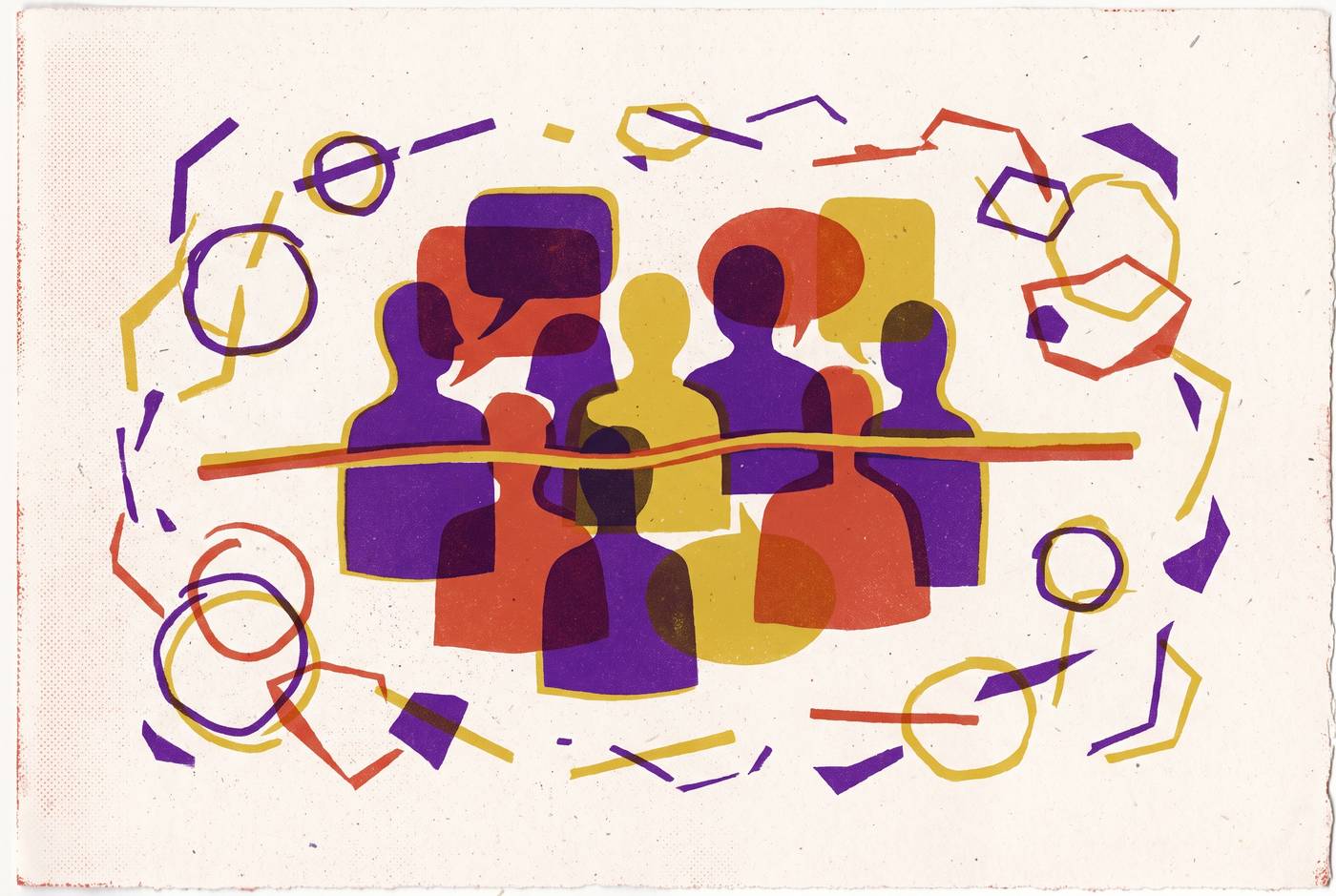
A board member describes the strategy one way, a sales leader describes it another, and an all-hands lands differently than intended. No one seems to have gone off-script, yet no one can explain why the accounts no longer line up. Each speaker believes they are expressing the same direction. The differences become clear only when employees or customers try to reconcile what they have heard. The organization has several confident narrators and no agreed plot.
The usual response is to work on the narrators. More coaching, more media training, or a new messaging framework promises to make leaders clearer and more consistent. These tools can improve delivery, but they cannot settle meaning that the organization has never formally agreed. Under pressure, several spokespeople must explain what the strategy means across different channels and as time goes on. A polished answer is still an interpretation if there is no governing language system underneath it.
That absence is the real failure mode. Each leader improvises from their own understanding, and variation compounds with every retelling. What looks like a personal communication weakness is therefore a structural gap. Storiedinc, a narrative and language systems firm serving founders and enterprises, treats that gap as an architectural problem. Its premise that business moves at the speed of clarity places the work where it belongs, in how the organization holds its story rather than how persuasively an executive delivers it.
What the pressure environment of 2026 is actually doing to executive communication
The conditions of 2026 put more weight on that missing structure. Geopolitical volatility forces decisions and explanations before the facts are complete. Workforce instability creates more questions about what those decisions mean for people. Compressed CEO tenures introduce more changes of direction and more gaps in interpretation. APCO's 2026 leadership outlook connects shrinking tenure with more frequent transitions, leaving stakeholders struggling to track the direction of travel.
Institute for Public Relations' March 2026 analysis describes how unclear policy forced CEOs in 2025 to speak before they had all the facts. Separately, major deals required leaders to address investors, employees, clients, and regulators at the same time. The Omnicom/Interpublic and Netflix/Warner Bros. Discovery cases illustrate that multi-audience problem. Investors seek clarity on value creation, while employees worry about their futures and clients about continuity. Regulators read the same words with market concentration in mind, so leaders need more than one statement copied into every channel.
Different audiences need different emphasis, but those differences must rest on the same account of the business. Meanwhile, AI lowers the effort required to produce reports, updates, and explanations, adding fluent material without necessarily adding clarity. More people can say more things faster, which is not quite the same as progress. APCO's 2026 outlook calls the wider environment a "permacrisis", describing a standing condition. The implication is structural, because these pressures keep raising the cost of operating without a shared language system rather than merely making an occasional announcement harder.
The structural mechanism — how language fragmentation actually happens inside organizations
External pressure exposes the gap, but fragmentation develops inside the organization. It begins when decision-making and language become disconnected. A change announcement may explain what will happen without making clear why action was taken now or which alternatives were considered. Employees then have to supply the missing logic themselves. A considered decision can look reactive because its reasoning did not travel with it.
Roadmaps and organizational structures begin to encode them, while vendor relationships and public commitments carry them further. Language stops merely describing a possible future and starts narrowing which futures remain possible. Changing the story now means revisiting choices made in its name. The problem has moved out of the presentation and into the business.
Language debt is the useful analogy here. It is deferred maintenance on shared meaning, compounding much as technical debt compounds in engineering. There need not be a single disastrous announcement, because the distance between narrative confidence and operational reality can widen gradually. Each unresolved difference makes the next repair more expensive. By the time leadership agrees that the story needs fixing, a rewrite is no longer enough.
Trust adds another cost to that repair. When employees keep seeing a gap between what leaders say and what the organization does, fresh words alone cannot win back their trust. People need to see changes in how the organization is governed before they can trust what it says next. Aileron's 2026 leadership communication analysis describes a manufacturing company president whose leadership team grew progressively quieter because the environment no longer invited contributions. That silence shows why fragmentation is not always noisy disagreement, since an organization can lose shared meaning while its meetings become deceptively peaceful.
What narrative infrastructure actually is — and what it is not
Narrative infrastructure is the governing layer that defines the organization's story, the language that carries it, and what may or may not change. At its center are a small number of dominant organizational narratives, the "big stories" expressing identity, purpose, and strategy. These stories remain subject to governance over time, beyond a project's completion and handover. The distinction matters because organizations keep changing after the final presentation.
A messaging framework serves a different purpose. It produces useful outputs, including key messages, talking points, and FAQs. But those outputs do not by themselves govern what happens when a new leader, audience, or decision tests their meaning. A communications plan can organize delivery without defining how the organization resolves conflicting interpretations. Both tools have their uses, but saving them in a folder called strategy does not make them infrastructure.
The test is whether the narrative changes behavior. Infrastructure appears in priorities, rituals, metrics, hiring decisions, product choices, and the trade-offs that guide investment. Institute for Public Relations' analysis describes the CEO as a "sense-maker" who provides context, coherence, and credibility. The person in that role needs a system that lasts, so internal governance and specialist language-system work, including Storiedinc's work on how the organization holds its story, serve a different need from help with a speech. Building that system early also avoids the more expensive work of unwinding fragmented meaning after it has hardened into commitments.
What does it take to build a story that scales as fast as the company does?
The system requires four connected components, namely a canonical narrative, decision rules for language, a governance structure, and operational integration. The canonical narrative comes first because people need an agreed reference before they can adapt it. Typically, that means one organizational narrative and a handful of supporting stories that are fixed, owned, and referenced for each occasion. Vision confined to the CEO's head, the board deck, or the annual offsite cannot reliably travel through the business. It must retain its meaning as leadership teams, managers, employees, customers, investors, and partners use it.
That reference must also be specific enough to be falsifiable. If the same language can justify any strategy or decision, it cannot distinguish alignment from drift. Decision rules then establish which words carry a category claim, which terms are in-bounds or out-of-bounds, and how the story can be adapted across audiences and channels. Adaptation changes emphasis without changing the underlying meaning. Otherwise, audience relevance becomes a polite name for contradiction.
Rules need governance because documents cannot adjudicate their own disputes. A named owner and a clear process establish who catches drift, who resolves it, and how the canonical version is reinstated. Without that responsibility, the next hiring cycle, acquisition, or reorganization can overwrite the agreed story. Aileron's manufacturing example illustrates the related danger at team level, where the absence of a structured communication environment became a signal in itself. Governance must let people question what the words mean as well as keep the approved wording under lock and key.
Operational integration puts that meaning into daily work to complete the system. The narrative must appear in onboarding, performance metrics, explanations of trade-offs, and accounts of what the company will not do. The practical test is whether a frontline team member answering an unexpected question reaches for language consistent with the executive's explanation. If not, the infrastructure has not reached the operating layer, however complete the documents look.
How AI changes what happens when narrative infrastructure is absent
AI makes gaps in that system more costly because it lowers the price of producing and repeating institutional language. Reports, summaries, proposals, and updates can multiply across departments without a governing layer to align them. Generative systems can absorb ambiguity into fluent output without supplying the judgment needed to resolve it. The result can sound settled even when the underlying meaning is not. Fragmentation acquires excellent grammar.
Research from March 2026 gives that risk a sharper edge. Researchers studying leading large language models found that they consistently recommended strategies aligned with managerial trends and unresponsive to context-specific logic. They called the pattern "strategy trendslop" and found that it persisted across varied prompting. For organizations using AI in strategy and communication work, polished output can carry a fashionable framing that does not fit the business.
This is why an unclear narrative is not a problem to hand to AI for tidying. Without governance, AI can amplify the dominant story already in circulation, including its ambiguity and inappropriate assumptions. With a governed canonical narrative, an organization can generate, filter, and extend content against an agreed reference. That reference gives people grounds to decide what to accept, challenge, ignore, or stop. The scarce asset is not another plausible paragraph, but meaning that survives repetition.
APCO's 2026 outlook notes that AI is changing how stakeholders seek information about a company. The company's narrative therefore has to be legible both to systems interpreting and surfacing it and to people reading an announcement. More output cannot compensate for conflicting accounts of what the business is doing. AI makes deferral harder to defend because it accelerates the very fragmentation that infrastructure is meant to contain.
What consistent executive communication looks like in practice when infrastructure is in place
With infrastructure in place, leaders can change tone, channel, and emphasis without changing the story. Leaders can focus on value creation when speaking to investors and discuss continuity and the reasons for a decision with employees. Both draw from the same account of what matters, what is changing, and how choices are being made. Consistency requires compatible meaning.
That shared account also makes proactive communication more substantive. Getting ahead of stakeholder questions requires leaders to examine which risks the organization faces, which scenarios they are considering, and how they intend to protect continuity. They can then explain their thinking before every variable is resolved, without substituting reassurance for reasoning. Credibility rests on context, transparency, and thinking that remains visibly consistent over time. Taking a position does not mean pretending to be perfectly right, while declining to take one can itself signal a lack of preparedness.
Managers have a basis for explaining trade-offs, and frontline employees can answer unexpected questions without inventing a local version of the strategy. To keep doing that as the company grows, it needs canonical documents, decision frameworks, and language governance that stay up to date. Storiedinc addresses this operating layer through Narrative OS and Storied AI, connecting its language-system work to the problem of governing consistency across an organization. These tools belong within the structural discipline.
Leaders can say they do not have all the facts while making clear how the organization is thinking and what guides its choices. Pressure still changes the questions, but it no longer forces every speaker to reconstruct the story from memory. Consistency was never fundamentally a style problem. Leaders who communicate well under pressure have better infrastructure underneath them.