Middle Management as a Language Risk Amplifier in Organizational Change
Managers unintentionally distort strategy through repeated translation down organizational layers.
Narrative infrastructure for hypergrowth companies is a governed language system that keeps strategy coherent as more people explain it. Middle management becomes a language risk amplifier when each manager must reconstruct that strategy for a team. Canonical language reduces the translation burden before change reaches the middle of the org chart.
Why change initiatives consistently stall in the middle of the org chart
A senior executive has a transformation designed at the top, explained to managers, and apparently dying somewhere in the middle. The familiar diagnosis is weak buy-in or resistance. But that diagnosis skips a prior question. Are teams resisting the same strategy, or acting on different interpretations of it? Agreement cannot produce coordinated action when the words being agreed to have different meanings.
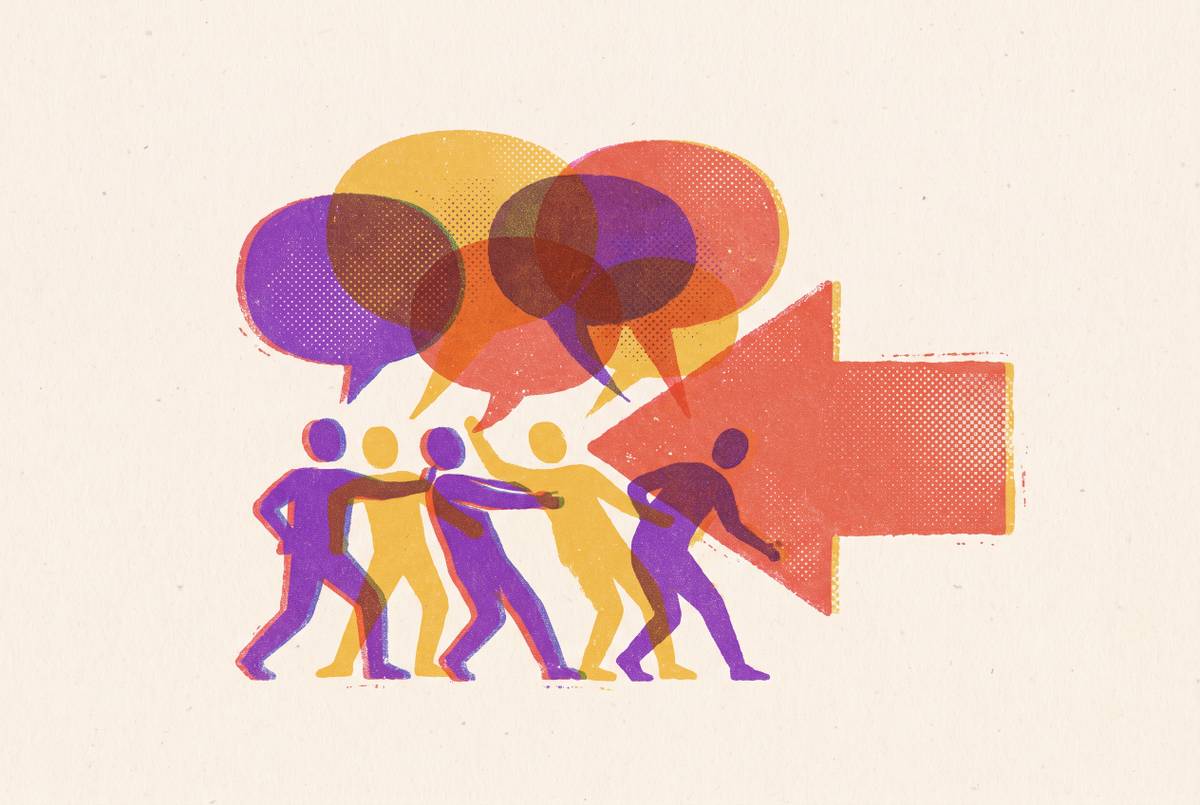
Middle managers sit right where those meanings branch. Monteiro and Almeida (2025) found that they operate as translators, enablers, and identity negotiators during change. Those roles pull in different directions. A manager must preserve strategic intent, make it workable locally, and explain what it means for people whose sense of their work may be changing. That is not message delivery with a slightly larger inbox.
Ahlberg and Zetterqvist (2025) describe middle managers as “tasked with translating the vision into reality”. The phrase sounds reassuring, but it assigns each manager responsibility for resolving whatever the original language leaves open. Town halls, briefing packs, and cascades can improve delivery without controlling that reinterpretation. Meaning must therefore survive the trip to the next layer.
What middle managers actually do to change language when they pass it down
Every hand-off by a manager calls for sensemaking, the work of fitting change to local conditions and a team’s identity. That work is also rewriting. Ahlberg and Zetterqvist’s study describes managers interpreting change for themselves while guiding others through it. Before a team acts, the language has passed through both a personal understanding and an explanation shaped for that team. The manager is not choosing between interpretation and fidelity, because interpretation is part of the job.
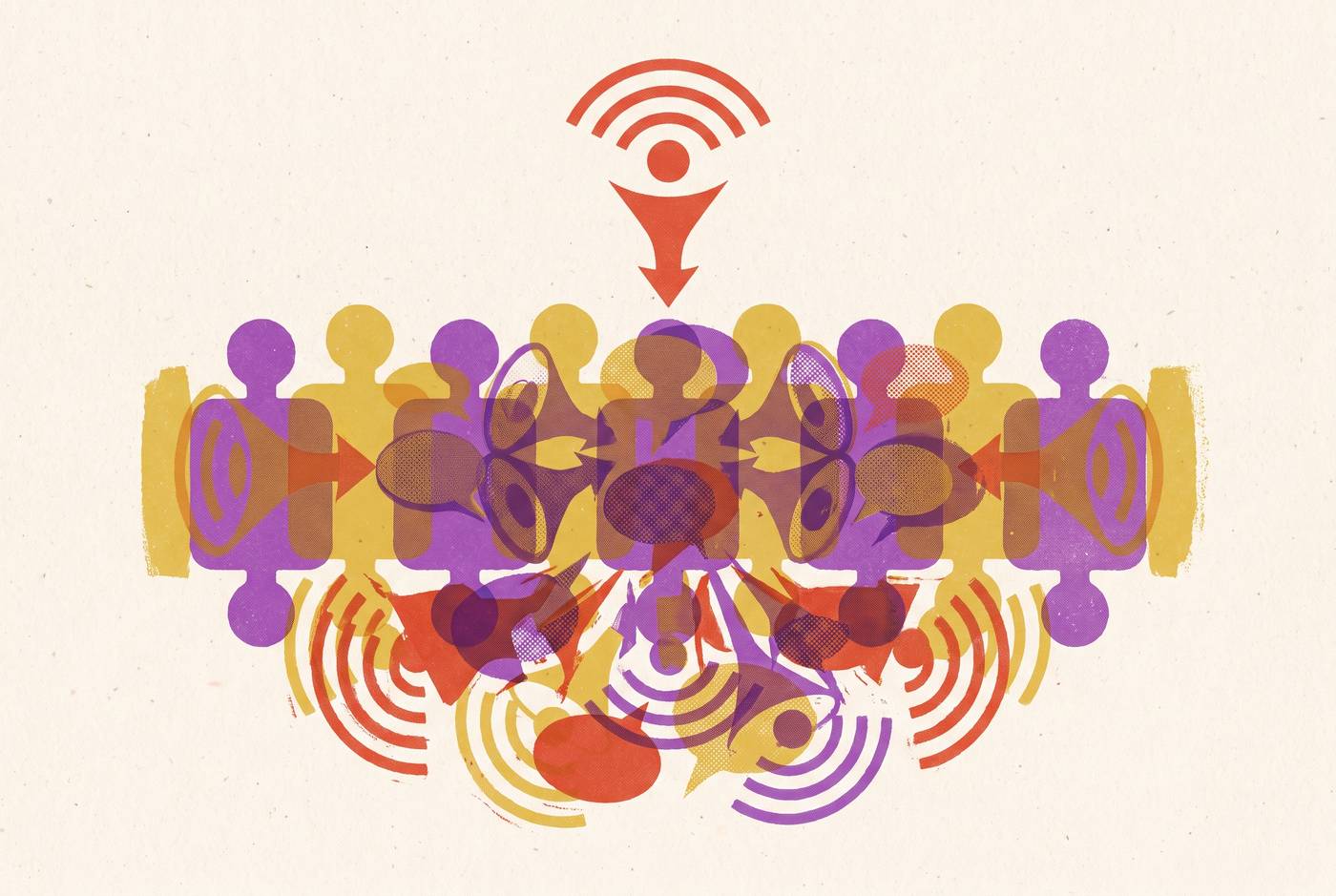
The pressure also runs in both directions. Strategic intent gets localized, softened, or reframed on its way down, while ground-level reality gets filtered or polished on its way up. Gellerman (2025) describes what goes wrong on the way up through the MUM effect, the way people tend to avoid sharing bad news. Strauss’s (2011) Upward Communication Distortion Index (UCDI) was developed to measure people’s propensity to distort upward organizational communication. The executive view can therefore be a reconstruction just as surely as the team’s view is.
Managers can mean well and still change the message in either direction. Monteiro and Almeida identify “communication ambiguities” and “balancing dual expectations” as structural challenges of the role. Boroş and Gorbatai (2024) describe managers as both “targets” and “agents” of change, having to absorb a disruption while helping others navigate it. One distorted translation may remain a communication glitch, but hundreds happening at once create a system in which no shared version can be assumed.
How individual translation errors compound into organization-wide language drift
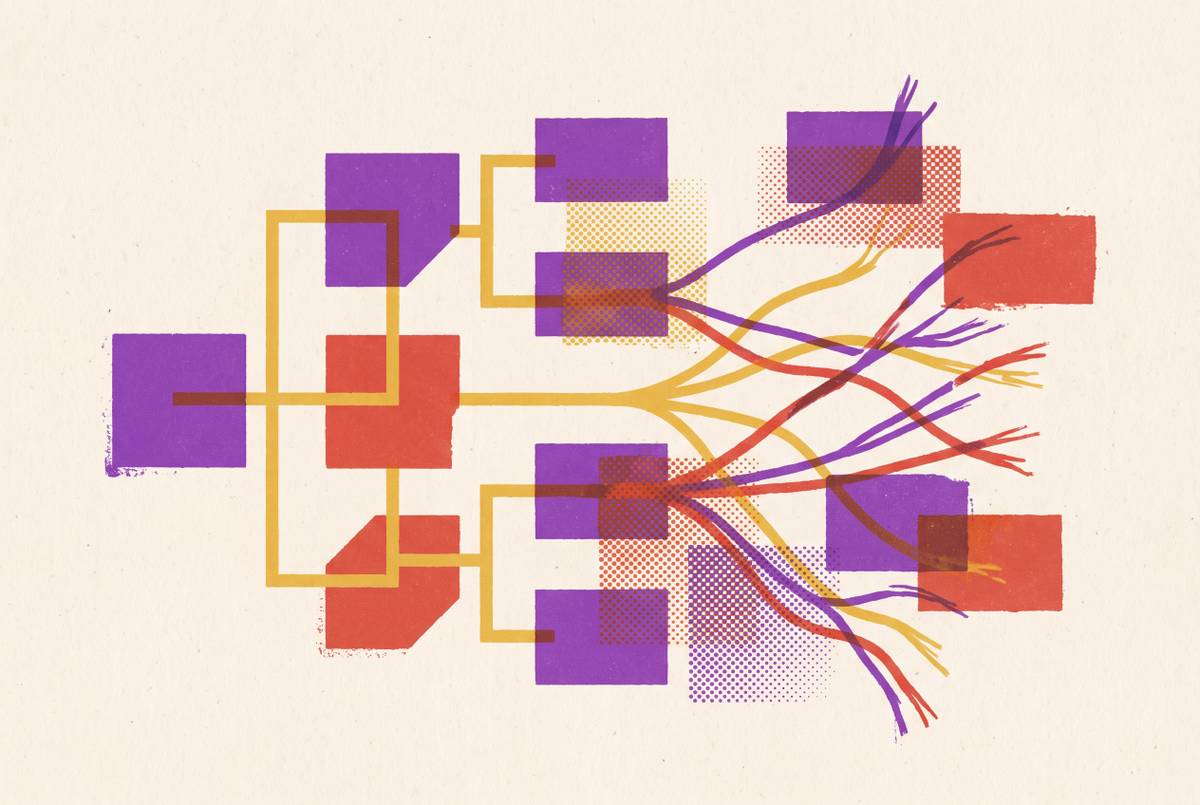
Each hand-off becomes a branching point when there is no common canonical reference. Each team gets a slightly different account, which changes again as people talk, meet, and make decisions. The versions do not have to be wildly wrong. Small differences in what people believe a strategy requires can still send work in different directions, particularly when those interpretations become the basis for further explanations.
Professional identity gives those branches a pattern. Ahlberg and Zetterqvist note that identity shapes managers’ interpretations, so different team contexts can produce meaningfully different versions of the same directive. Monteiro and Almeida identify “informal learning” as part of how managers navigate change. Peer explanations therefore circulate beside official language and sometimes take its place. The organization acquires a parallel account of its strategy without having deliberately authored one.
This accumulated divergence is language debt. Like technical debt in a codebase, each local shortcut looks manageable while the combined effect makes the whole system harder to work with. The cost arrives as rework. Onboarding takes longer, managers spend more time clarifying instructions, and capable employees miss productivity targets because the language guiding their work has become inconsistent. It is easy to blame these problems on gaps in training or on poor management.
The debt remains even when layers of management are removed. Kusmaryanto and Santoso (2025) establish that middle managers remain essential in public sector digital transformation, where removing them leaves communication and coordination gaps that digital tools do not automatically fill. Change involving abstract technical goals or identity-sensitive policies creates especially acute risks by leaving more room for consequential differences in interpretation.
Why digital transformation and DEI initiatives expose the translation failure most sharply
Digital transformation asks managers to link abstract language about the future to the work their teams face today. That gap demands interpretation before implementation can begin. Kusmaryanto and Santoso describe managers’ roles in this setting as “ambiguous, complex, and paradoxical”, with responses ranging from positive to negative. The language has a difficult job to do. It must explain a changing operational reality without leaving each manager to invent the connection between the strategy and the work.
Digitalization also changes competency and training needs. If the words defining those needs are unclear, retraining can add competing interpretations. A team may receive more instruction while remaining uncertain about what the transformation requires. The weakness sits upstream of delivery. Teaching an unclear concept more thoroughly does not give it a stable meaning.
DEI implementation adds a further interpretive layer. Boroş and Gorbatai call it “a particularly treacherous type of organizational change for middle managers” because identity-related tensions compound ordinary implementation pressures. Those tensions affect people, groups, and the organization as a whole, so each reads the same policy language through different filters. Their use of the Leading Diversity (LeaD) model stresses the need for cognitive understanding and social perceptiveness as well as the skill to communicate. A polished explanation cannot substitute for understanding what a policy means for the people hearing it.
Both contexts expose the same structural weakness. Sophisticated strategies pass through an uncontrolled translation layer, while implementation difficulties get attributed to resistance, culture, or manager quality. Human judgment is indispensable in both cases, but ambiguous source language gives it unnecessary reconstruction work. AI introduces a different scale of consequence. The versions that once circulated among teams can now become material for automated communications, summaries, and recommendations.
What happens when AI systems train on language that has already drifted
When AI systems work from organizational language that has drifted, they do not automatically recover what it was first meant to say. They synthesize the material available to them, including its contradictions. If that material contains six manager-translated versions of a strategy, an output can combine partial truths into an authoritative-sounding account that matches none of the intended meaning. The failure is not necessarily hallucination, but distortion assembled from real fragments.
That distinction changes the risk for AI-enabled organizations. A local misunderstanding can enter generated communications and recommendations that represent the company beyond the team where it began. Internal friction becomes an external signal problem. Language that previously required a person to repeat it can now be reproduced at a scale no human communication layer could match, without the organization recognizing how far the meaning has moved.
There is also a risk of narrative flattening. When the company’s own language is weak or contradictory, generic industry phrases can dominate the synthesis, making its outputs harder to distinguish from competitors’ language. Familiar wording fills the gaps. Managers translating an abstract strategy may also reach for familiar category language, so human interpretation and AI generation can reinforce the same loss of specificity.
Narrative precision belongs before AI deployment. A language infrastructure approach gives people and systems a stable reference rather than expecting either to reconcile accumulated contradictions. It addresses the quality of the source material before amplification makes drift harder to contain.
Why more communication volume makes the translation problem worse, not better
The intuitive response to confusion is another message. Then comes another briefing, followed by a town hall to explain the briefing. The intention is reasonable, but the diagnosis is wrong. Sending more messages cannot settle meanings that people never agreed on, and each new message can give managers another version to work out after taking in only part of it. A quantity response adds work to a quality problem.
Volume fatigue makes that work harder. As employees read less carefully, key language gets buried and managers must pull what their teams need from a growing pile of messages. That extraction is another act of rewriting. Instead of reducing the translation burden, over-communication transfers more of it to the people already responsible for turning broad intent into workable direction. The inbox becomes a second job description.
Senior leaders can appear aligned because they use the same words while meaning different things by them. Shared vocabulary is not shared meaning. When executives use the same words to mean different things in their messages, managers get mixed signals and have no stable source text to check them against. Asking the next layer to pass the message on more faithfully cannot settle what leaders never agreed on.
The cascade is architecturally weak because it relies on sequential human reinterpretation without a mechanism for checking whether meaning remains faithful to the source. Monteiro and Almeida’s account of informal learning shows how peer networks fill the resulting gaps through a parallel channel. Additional volume does not displace that channel, because people still need help interpreting what they receive. Better manager briefing leaves the central dependency intact if every manager must still reconstruct the strategy.
How do fast-scaling companies build governed language that communication programs cannot provide?
Governed canonical language changes what managers receive. Instead of a message whose gaps they must fill, it provides a stable reference for what the strategy’s words mean and how they fit together. Context still needs judgment, but strategic intent need not be reinvented. A communication plan specifies what to say, while canonical language establishes the meaning that must survive different explanations. The distinction is between a script and a grammar.
For fast-scaling companies, this is narrative infrastructure. Its defining criteria are clear ownership of language decisions, a way to detect and correct drift, and a process for changing the language as strategy changes. A glossary alone cannot do that work. Nor can a brand guide settle competing interpretations simply by existing, because governance requires authority over which meaning is canonical and how deviations get resolved.
This structure reduces the translation burden without pretending that managers can stop interpreting their circumstances. Monteiro and Almeida identify “translating strategies into practice” and “building trust” as part of successful change work. Both become lower-risk when the strategic language is unambiguous before managers receive it. Judgment belongs in deciding how to apply the strategy to the work at hand. It should not be consumed by reconstructing what senior leaders might have meant.
Boroş and Gorbatai identify paradox mindset and emotional capabilities as preconditions for success in DEI implementation. Canonical language removes unnecessary ambiguity from the work those capabilities support and gives AI systems a cleaner, more consistent signal.
Language was operating as unmanaged infrastructure, with every hand-off creating another opportunity for meaning to drift. The question for a growing organization is therefore not how to train managers to communicate better. It is whether the company has a language system that does not require translation.
Sources
- Full article: A scoping review of middle managers in the digital transformation era in public sector organizations: are they still needed?
- Walking the tight rope of DEI implementation: paradox mindset and emotional capabilities as preconditions for middle managers' success
- "Upward Distortion and Organizational Culture" by Benjamin Gellerman
- Middle Managers as Change Agents: A Grounded Theory ...
- Managing Change How Middle Managers Navigate Organizational Change