Positioning Drift Across Distributed Enterprise Sales Teams
Govern positioning language at the source before it fragments across your sales teams.
Positioning drift across distributed enterprise sales teams is a structural problem. The durable fix is to govern what the company’s language means before it reaches the field. For platform and deep-tech companies, that means using a category buyers understand whenever it fits, and creating new category language only when existing frames cannot explain the technology.
Why positioning drift is misdiagnosed as a people problem
Ask the three most recently hired reps to explain, in one sentence, why a qualified buyer should choose the company over its nearest competitor. Do not announce that it is a test. If the answers give different reasons to buy, the variation is the bottleneck. What matters is whether the reps appear to be selling the same strategic choice.
That distinction separates positioning from messaging. Positioning is the set of internal strategic decisions about where the company competes and why it should win. Messaging is the customer-facing expression of those decisions, so different words can still express the same position. A message that cannot be traced to that foundation is positioning drift.
Yet the usual response targets the person delivering it. More training, tighter scripts, and better enablement decks all assume that the right answer exists and the rep has failed to learn it. When the underlying decisions remain unresolved, those interventions leave the cause intact. A fresher deck cannot settle an unresolved strategy. Different teams continue to tell different versions of the work, while each new audience prompts another improvised story decision.
The structural mechanism behind drift: how it actually forms at scale
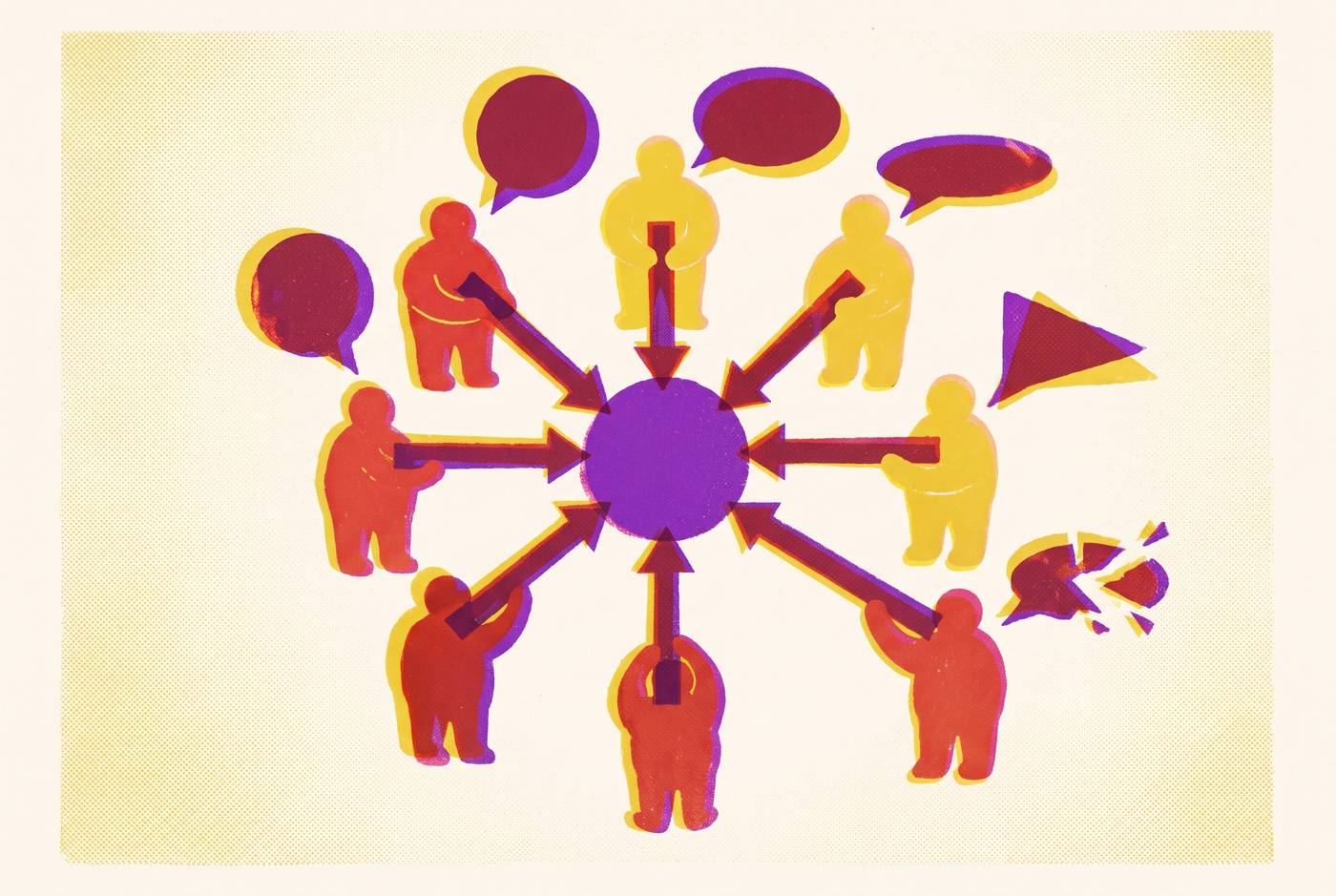
Account executives anchor conversations in present market reality, including what buyers are comparing the company against this quarter. Product teams may be building for a different position. Neither perspective is inherently wrong, but without a governing anchor, the gap between them widens deal by deal. Local adaptation becomes the working definition of the company. As the company grows, that gap becomes a recurring pattern.
The same process runs across functions. Each develops language and metrics that make sense for its own work but obscure meaning elsewhere. When information travels without its context, the receiving team has to interpret it. Those interpretations can be locally sensible and collectively incompatible. Silos form around what matters to each team, even when people mean well.
As governance weakens, channels accumulate and leadership communication depends more on individual habits. Employees filter out more, ignore more, and turn to people they know to fill in the context. That response helps them navigate their immediate work, but it does not supply a common definition for the next team or new hire. Goodwill cannot fill a structural gap indefinitely. So efforts to change the culture miss the cause when teams lack a shared set of definitions.
Buyers can have a shortlist before they raise their hands, so inconsistent descriptions can affect which alternatives they consider in the first place. Drift is not just a problem of closing an opportunity already in the pipeline. It can change whether the company belongs in the buyer’s consideration set at all.
Why narrative is infrastructure, not messaging
Narrative infrastructure is a governed language system that makes strategy usable across the organization. It connects where the company is going with why that direction deserves attention and what must be abandoned to pursue it. Without those links, people can keep working while losing their shared understanding. Each team chooses its own direction. Narrative is therefore not the story added after strategy is finished, but part of how strategy becomes work.
Its practical test is whether it changes behavior. A strategic narrative has to guide priorities, rituals, metrics, trade-offs, hiring, product choices, and the way meetings run. If it changes only the opening slides of a presentation, it remains a communications output. People need to derive decisions from the narrative.
Narrative infrastructure governs what language means, who owns it, and how it reaches different functions and new hires. Consistent capitalization is useful, but it does not establish a consistent reason to buy. A company can look good in every font and still be off-message. The foundation has to exist before the customer-facing expression can reliably follow it.
Storied’s Narrative OS gives this concept an operational form by treating positioning as a living system managed across an organization at scale. Its relevance here is the shift from broadcasting a story to wiring language into how the company works. That shift changes the unit of repair. Instead of correcting one deck or one rep, the organization governs the definitions from which both derive their answers.
Language debt: what fragmented organizational language actually costs
Language debt is the accumulated cost of fragmented organizational meaning. Like technical debt, it can grow through day-to-day work without its own line in the budget. In sales, fragmented organizational meaning causes stalled pipeline, work done over again, and lost deals blamed on product gaps. The expense arrives under somebody else’s name. That makes it easy to fund a response to the visible symptom while leaving the source untouched.
Deloitte’s 2026 Global Technology Leadership Study estimates that technical debt consumes a substantial share of enterprise IT spending annually. That provides a useful analogy for language debt. The parallel is that unresolved foundational problems impose costs on work built above them. Fixing the latest proposal does not fix the definitions that made the proposal wrong. The next team still inherits the same ambiguity.
Because the cost is diffuse, the diagnosis can point toward a competitive disadvantage, a missing product capability, or weak rep performance. Language debt may remain unnoticed until a deal stalls, a category gets misclaimed, or a new hire produces something fluent but fundamentally off-message. Any one of those events on its own is too little to prove that language caused the problem. Each exposes a place where the underlying definitions deserve scrutiny.
Retiring that debt requires a discipline analogous to code-quality practices. Definitions of metrics need to be established once, governed centrally, and applied across the organization. The same discipline applies to the strategic terms those metrics support. Otherwise, each repair stays local while the original ambiguity remains available for reuse. The cost is not merely having to rewrite sentences, but repeatedly doing work from incompatible premises.
How AI amplifies language debt instead of resolving it
AI increases the volume of material that a fragmented language system can produce. Reports, presentations, proposals, summaries, and analysis can all become more abundant without becoming more coherent. If the definitions behind them clash, writing that reads well makes those clashes sound more convincing. Improved prose can make language debt both easier to spread and harder to spot.
Intento’s 2025 State of Translation Automation report highlights the importance of meeting explicit requirements, including terminology, tone, formatting, and consistency. Its lesson for this argument is narrower than a claim that fluency solves communication. In enterprise sales, an AI-assisted proposal can sound competent while expressing the wrong competitive frame. Even work that reads well needs shared rules for checking whether it is correct.
When there is plenty of output, what is in short supply is a shared way to decide which of it to act on. A company with a clear narrative can distinguish what to generate, ignore, challenge, and use. Without one, more output creates more material to interpret. The organization can produce faster and still move no faster.
The risk also reaches the buyer’s side of the process. AI-assisted vendor evaluation can filter weak positioning before a human reviewer engages, increasing the cost of language that does not clearly establish what the company does and where it belongs. This is a reason to make the strategic definitions precise. AI gives an unclear narrative more places to go wrong.
How do you frame technology that fits no existing category without creating more drift?
For platform and deep-tech companies, new category language is justified when no existing category captures what the technology does. A lack of search demand or an analyst’s wrong bucket does not, by itself, make an invented label the answer. An existing frame must explain the company credibly and specifically to qualify. Novelty alone is not a naming strategy. When a familiar category fits, explaining the company clearly within it spares every rep the work of teaching buyers a new one.
Category creation can be a powerful positioning move because naming a space lets a company define the conversation around it. Drift named “conversational marketing,” and competitors entering that space were following the frame it had established. Salesloft’s acquisition of Drift, announced February 2024, began redirecting the product. Clari + Salesloft announced Drift’s gradual sunset on March 5–6, 2026, and named 1mind as the exclusive successor. The category’s absorption into a larger platform shows the limits of naming as a lasting defense.
For a company facing a genuine blank-category problem, the lesson is coordinated market education. That requires mobilization through a major piece of thought leadership, a conference keynote, or a market research report that names the problem and positions the company as the answer. A new label in a sales deck cannot perform that work. Without coordination, distributed reps have to explain not only the product but also the category, and each explanation becomes another opportunity for drift.
What narrative governance actually looks like in a distributed sales organization
The operational response is to build a system around the places where meaning degrades. Four components define that system, namely leadership narrative, delivery infrastructure, governance, and feedback. Leadership narrative provides the shared spine, while delivery infrastructure determines how it reaches the field. Governance establishes ownership, change rules, and drift detection. Feedback gives market reality a path back into the system.
These components need a common reference. Canonical documents provide structured, versioned language assets that serve as the source of definitional truth. Their job is to preserve meaning across functions. Edit access is not a governance model. The practical test is whether an operator in any function, at any seniority level, can derive a consistent account of how the company is positioned from the same source.
Change needs rules too, because a correct update can create fresh drift if it travels informally. A product shift, competitive entry, or category move requires a governed update process rather than propagation through Slack and revised slide templates. The system has to specify who owns the change and how the revised position reaches the field. Otherwise, people keep using both the old and the new definitions. The update then becomes another source of ambiguity.
Field feedback closes the loop by bringing in what buyers compare the company against this quarter, which language lands, and which language falls flat. Without that return path, the company can become internally consistent while drifting away from the market. This is the role of Narrative OS as a protocol, and where Storied’s approach belongs in the operating model. The work is to connect definition, delivery, ownership, and revision into one governed system. Reps can then adapt an explanation to the buyer without having to invent the company behind it.